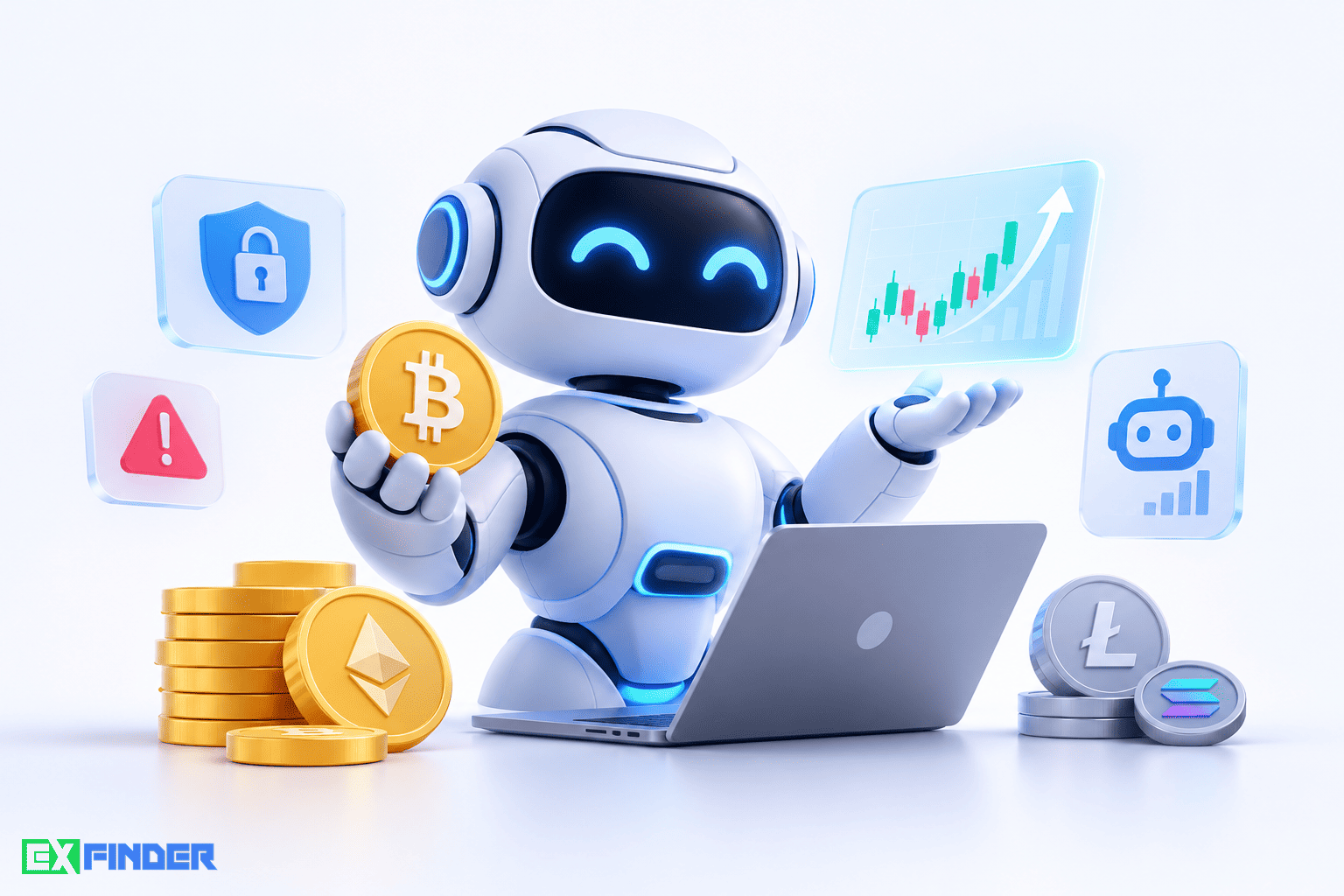
The trading of digital assets demands ultra-fast reaction times, real-time data processing across multiple chains, and unyielding emotional discipline. Operating in a 24/7 global environment, cryptocurrency markets have outgrown traditional manual analysis, giving way to next-generation algorithmic solutions. Modern AI trading bots have evolved far beyond basic rule-based scripts into adaptive intelligent systems capable of processing unstructured data, self-optimizing technical indicators, conducting real-time sentiment analysis, and managing systemic risk. However, using artificial intelligence in financial markets carries substantial technical risks—including model overfitting, API security vulnerabilities, black swan sensitivity, and liquidity traps. Success requires a sophisticated synthesis of AI algorithms, rigorous operational security, and dynamic risk management protocols.
1. Introduction & The Paradigm Shift in Algorithmic Trading
The cryptocurrency market operates under unique structural dynamics that distinguish it from traditional equity and forex markets. Unprecedented 24/7 market hours, extreme price volatility, fragmented liquidity across centralized (CEX) and decentralized (DEX) exchanges, and instantaneous sentiment swings driven by social media create an environment where human processing speed is mathematically inadequate. To remain competitive, institutional and retail market participants are migrating to automated execution environments powered by Artificial Intelligence (AI) and Machine Learning (ML).
Over the past decade, algorithmic trading has undergone a fundamental transformation. While early automated systems relied on static logical conditionals, modern trading systems leverage deep neural networks, natural language processing (NLP), and predictive analytics to continuously interpret complex market regimes. The modern AI bot does not merely execute predefined commands; it perceives market structure, calculates probability distributions, measures volatility clusters, and adjusts its trading parameters dynamically without requiring manual code refactoring.
2. Evolution of Crypto Bots: From Basic Scripts to Machine Learning
Understanding the value of modern AI trading systems requires analyzing the structural evolution of trade automation over three distinct technological generations:
2.1. First-Generation Rule-Based Bots (Rule-Based Automation)
Early trading bots relied entirely on hardcoded, deterministic rules using simple conditional logic (e.g., IF RSI < 30 AND EMA_50 > EMA_200 THEN BUY). While these scripts successfully eliminated human execution latency, they suffered from complete structural rigidity. When market regimes shifted from high-volatility trending environments to low-volatility range-bound consolidation, rule-based algorithms suffered massive drawdowns because they could not adapt their underlying assumptions.
2.2. Second-Generation Quantitative Bots (Statistical Arbitrage)
The second iteration introduced statistical modeling, mean-reversion algorithms, and automated grid-trading strategies. These bots utilized statistical metrics to identify temporary price inefficiencies between trading pairs or across separate exchanges. However, they remained fundamentally reactive rather than predictive, relying on historical backtesting under the flawed assumption that future volatility would mirror past price distributions.
2.3. Third-Generation AI & Deep Learning Systems (Adaptive Neural Intelligence)
Contemporary AI bots combine artificial neural networks (ANNs), reinforcement learning (RL), and Large Language Models (LLMs). Rather than following fixed rules, these systems analyze millions of data points across multiple channels simultaneously: order book depth, on-chain whale wallet movements, derivatives funding rates, macroeconomic indicators, and real-time social sentiment. Through continuous reinforcement learning, the model evaluates its own profit-and-loss (PnL) metrics, fine-tuning its weight parameters to maximize risk-adjusted returns (Sharpe and Sortino Ratios).
3. Core Strategic Advantages of AI Trading Bots
Deploying artificial intelligence within digital asset markets yields structural capabilities that human traders cannot replicate manually:
3.1. 24/7 Continuous Market Surveillance
Cryptocurrency prices react instantly to global macroeconomic developments, regulatory announcements, and liquidity events regardless of local time zones. AI trading bots maintain continuous, millisecond-level surveillance across thousands of trading pairs simultaneously, executing trade entries or emergency risk mitigations at any hour without cognitive fatigue.
3.2. Complete Elimination of Behavioral & Emotional Biases
Behavioral finance demonstrates that emotional responses—specifically FOMO (Fear Of Missing Out), loss aversion, and revenge trading—are the primary drivers of retail trader liquidations. AI systems operate purely on statistical probabilities and mathematical models. They execute stop-loss orders without hesitation and take profits strictly according to pre-calculated probability curves, completely insulating portfolio management from emotional bias.
3.3. Microsecond Execution & Slippage Reduction
In high-frequency trading (HFT) and cross-exchange arbitrage, execution speed dictates profitability. AI bots connected directly to exchange WebSocket APIs can process market data and transmit order executions in microsecond timeframes. This minimizes slippage—the price discrepancy between order placement and order fill—thereby preserving profit margins during periods of violent volatility.
3.4. Multi-Dimensional Data Aggregation & Pattern Recognition
A human trader can typically monitor only a few charts and indicators at once. Modern AI models analyze multi-dimensional datasets simultaneously: combining technical oscillators, order book bid-ask imbalances, options market skew, on-chain exchange net-inflows, and NLP sentiment metrics extracted from news feeds and social media platforms. This holistic view enables the detection of non-linear correlations invisible to human analysis.
3.5. Dynamic Backtesting, Forward Testing, and Self-Optimization
Unlike static algorithms, AI trading systems continuously validate their predictive accuracy using forward-testing environments and machine learning feedback loops. By comparing expected probability distributions against realized price movement, the AI automatically re-calibrates its internal model weights to adapt to shifting market volatility regimes.
4. Taxonomy of AI Crypto Trading Strategies
AI trading bots are categorized based on their underlying quantitative architecture and execution objectives. The table below outlines the primary operational categories deployed across crypto markets:
| Strategy Category | Core Operating Mechanics | Optimal Market Regime | Risk Profile |
|---|---|---|---|
| AI Grid Trading | Dynamically expands and contracts grid order levels based on AI volatility forecasts (ATR). | Ranging / Consolidation | Low to Medium |
| Predictive Machine Learning | Uses recurrent neural networks (LSTM/Transformers) to forecast short-term price vectors. | High-Volume Trending | Medium to High |
| Cross-Exchange Arbitrage | Identifies price discrepancies for identical assets across DEXs and CEXs, executing atomic swaps. | High Volatility / Inefficient Liquidity | Low (Execution-Dependent) |
| NLP Sentiment Trading | Scrapes news and social feeds using Large Language Models to trade instantly on breakings news events. | Event-Driven / News Spikes | High |
| DeFi Yield & Rebalancing | Automates liquidity provision across DEX protocols to maximize yield while hedging impermanent loss. | Stable / Yield-Farming Regimes | Medium |
| DEX Liquidity Snipers | Monitors mempools to purchase new tokens within the exact block their liquidity pools are created. | Early Token Launches | Extremely High |
5. Deep-Dive: Technical Architecture of an Advanced AI Bot
To operate effectively in competitive crypto markets, an enterprise-grade AI trading bot relies on a modular, four-layer software architecture designed for high throughput, low latency, and fault tolerance.
5.1. Data Ingestion & Preprocessing Layer
This layer maintains persistent, low-latency WebSocket connections to centralized exchange order books, decentralized smart contract event logs, and external API feeds. Raw data feeds—such as trade executions, order book depth delta, and gas prices—are normalized, cleaned of anomalies, and converted into structured feature vectors for model consumption.
5.2. AI Inference Engine & Machine Learning Core
The core intelligence of the system typically employs Long Short-Term Memory (LSTM) networks, Temporal Convolutional Networks (TCNs), or Transformer architectures tailored for time-series forecasting. Simultaneously, Reinforcement Learning (RL) agents evaluate actions (Buy, Sell, Hold, Adjust Leverage) based on a reward function optimized for risk-adjusted returns (such as maximizing the Calmar Ratio while capping Maximum Drawdown).
5.3. Dynamic Risk Management Engine
Before any signal generated by the AI core reaches the execution layer, it must pass through an independent Risk Engine. This subsystem enforces hard-coded constraints: calculating Value at Risk (VaR), checking position size limits relative to order book depth, determining dynamic Stop-Loss levels based on Average True Range (ATR), and verifying overall portfolio margin health to prevent liquidation cascade risks.
5.4. Execution & API Communication Layer
The execution layer handles order routing, nonce management, and network communication with exchange APIs or blockchain RPC nodes. In high-frequency strategies, this layer utilizes direct co-location servers, optimized HTTP/3 or FIX protocols, and specialized smart contract execution (such as Flashbots for MEV protection on Ethereum) to prevent front-running by competing bots.
6. Risks, Vulnerabilities, and the Dark Side of Automation
While AI trading bots offer powerful capabilities, they are not a guaranteed path to passive income. Deploying automated systems exposes capital to severe technical, algorithmic, and operational risks that can result in total capital loss if mismanaged.
⚠️ Critical Systemic & Technical Risks:
- Model Overfitting (Curve Fitting): An AI model trained too aggressively on historical price data can memorize past noise rather than learning genuine market dynamics. Such models produce spectacular results in backtests but fail catastrophically when deployed in live market conditions.
- API Security & Key Exploits: Granting third-party trading bots access to exchange accounts via API keys exposes users to severe security risks. If an API key is leaked or a bot platform suffers a database breach, malicious actors can execute trades designed to drain funds (e.g., cross-trading illiquid pairs) or withdraw assets directly if withdrawal permissions were mistakenly enabled.
- Sensitivity to "Black Swan" Events: AI models make statistical predictions based on historical distributions. During unprecedented macro events—such as exchange collapses, stablecoin de-pegging, or sudden regulatory bans—AI models frequently misinterpret price action, executing high-conviction trades directly into catastrophic market meltdowns.
- Latency Bottlenecks & Slippage Traps: During extreme market congestion, exchange APIs frequently suffer latency spikes, rate limits, or outright outages. A bot attempting to execute an emergency stop-loss may experience severe slippage or failed executions, incurring losses far beyond the intended risk threshold.
- Hyper-Trading & Fee Erosion: High-frequency AI strategies can execute thousands of micro-trades daily. If trading fees (Maker/Taker fees, network gas, funding rates) are not factored into the model's reward function, accumulated transaction costs can consume all gross profits, resulting in a net negative portfolio return.
7. Comparative Framework: Human Trader vs. Traditional Bot vs. AI Trading System
Evaluating trade execution methods highlights the distinct operational trade-offs between manual trading, deterministic scripts, and adaptive AI architectures:
| Operational Metric | Manual Human Trader | Rule-Based Bot (Gen 1/2) | Adaptive AI System (Gen 3) |
|---|---|---|---|
| Execution Speed | Slow (500ms – 3 seconds) | Fast (10ms – 100ms) | Ultra-Fast (\<10ms via API) |
| Operational Hours | Limited (8–12 hours/day) | 24/7/365 Continuous | 24/7/365 Continuous |
| Emotional Discipline | Very Low (Vulnerable to FOMO/Panic) | Absolute (Strict Code) | Absolute (Probabilistic) |
| Market Adaptability | High Intuition, Slow Execution | Zero (Fails on Regime Shift) | High (Self-Learning ML Core) |
| Data Processing Scope | Single Chart / Limited Metrics | 2–3 Technical Indicators | Multi-Dimensional (On-chain, NLP, Book) |
| Setup Complexity | None (Requires Trading Skill) | Low (Simple Logic Parameters) | High (Requires ML Infrastructure & Hygiene) |
8. Step-by-Step Security & Operational Checklist
To protect capital when configuring and operating automated AI trading systems, follow this strict operational security protocol:
🔒 Security & Deployment Protocol:
- Restrict API Permissions: When generating API keys on centralized exchanges, grant access **exclusively** for Reading and Trading. **NEVER** enable "Withdrawal" or "Transfer" permissions for any trading bot API key.
- Enforce IP Address Whitelisting: Restrict your API key usage exclusively to the static IP address of the dedicated server or Virtual Private Server (VPS) hosting your trading bot.
- Mandatory Multi-Factor Authentication (MFA): Enable hardware-key (e.g., YubiKey) or app-based 2FA across both your exchange accounts and your bot platform dashboards.
- Paper Trading Validation: Run any new AI model or strategy in a simulated "Paper Trading" environment for a minimum of 30 days to evaluate drawdown metrics across various volatility conditions before committing real capital.
- Hardcoded Global Circuit Breakers: Implement independent stop-loss mechanisms at the account level (e.g., automatically terminating all bot API permissions if total portfolio drawdown exceeds 5% in a single day).
- Continuous Monitoring & Retraining: Never operate an AI bot under a "set and forget" assumption. Regularly review trade logs, verify model drift, and audit active API key permissions.
9. Future Outlook: Autonomous Web3 Economic Agents & zkML
The integration of artificial intelligence into digital asset markets is rapidly progressing toward several major technological milestones that will redefine global finance over the next decade:
9.1. Autonomous Economic Agents (AEA) in Web3
The industry is transitioning from simple exchange trading bots toward fully autonomous Web3 AI agents. Equipped with non-custodial cryptographic wallets, these agents can evaluate yield opportunities across decentralized finance (DeFi) protocols, execute cross-chain liquidity rebalancing, pay for their own server infrastructure, and engage in machine-to-machine (M2M) micro-transactions without human oversight.
9.2. Zero-Knowledge Machine Learning (zkML) Integration
A primary challenge in algorithmic trading marketplaces is verifying that a commercial bot actually executes the specific AI model promised by its developers. Zero-Knowledge Machine Learning (zkML) solves this by generating cryptographic proofs verifying that a model's output was computed correctly from specific inputs—without exposing the proprietary model weights or underlying trade signals to the public.
9.3. Natural Language Trading Interfaces (NLT)
Large Language Models are democratizing access to complex quantitative strategies. Rather than manually writing Python code or building complex logical structures, traders can instruct AI execution systems using conversational language: "Deploy a market-neutral delta-hedged strategy on ETH options with a maximum drawdown limit of 4% and automated grid rebalancing during low volatility."
10. Frequently Asked Questions (FAQ)
Are AI crypto trading bots profitable out of the box?
No off-the-shelf trading bot guarantees consistent profitability. Market efficiency dictates that publicly accessible, pre-configured strategies quickly lose their edge as more participants deploy them. Long-term profitability requires continuous optimization, sound risk management, and strategic adaptation to changing market conditions.
Can an AI bot trade on Decentralized Exchanges (DEXs)?
Yes. Specialized DeFi bots connect directly to blockchain RPC nodes, interacting with decentralized exchange smart contracts (such as Uniswap or Raydium). These bots execute swaps on-chain and frequently monitor the blockchain mempool to optimize transaction gas fees and protect against Maximum Extractable Value (MEV) sandwich attacks.
What is the difference between a grid bot and an AI bot?
A traditional grid bot places buy and sell orders at fixed percentage intervals within a predetermined price range, regardless of market conditions. An AI grid bot dynamically adjusts grid spacing, order sizes, and entry/exit boundaries based on real-time volatility forecasts, order book depth, and predictive market metrics.
What constitutes the biggest threat to AI bot performance?
The single largest threat is a radical market regime shift—such as a sudden transition from a low-volatility range into an aggressive trend caused by an unexpected macroeconomic event. If the AI model has not been trained on similar market dynamics, it may continue executing strategies unsuited for the new regime, resulting in rapid capital drawdowns.
11. Conclusion
Artificial intelligence trading bots represent a transformative leap forward in digital asset management, granting market participants unprecedented computational speed, continuous market monitoring, and disciplined, emotionless execution. By combining multi-dimensional data analysis with automated execution, AI tools equalize the technical capabilities between retail investors and institutional trading desks.
However, automation does not eliminate market risk. AI trading bots are complex tools that require diligent human supervision, rigorous API security protocols, and robust risk management structures. When deployed responsibly as part of a well-engineered trading framework, AI bots serve as powerful force multipliers—allowing traders to navigate the complexities of 24/7 crypto markets with precision, discipline, and technological agility.
Looking to stay ahead of market trends and optimize your digital asset exchanges? Utilize our intelligent crypto monitoring tools today to secure fast, reliable, and cost-effective currency exchanges at the industry's best rates!