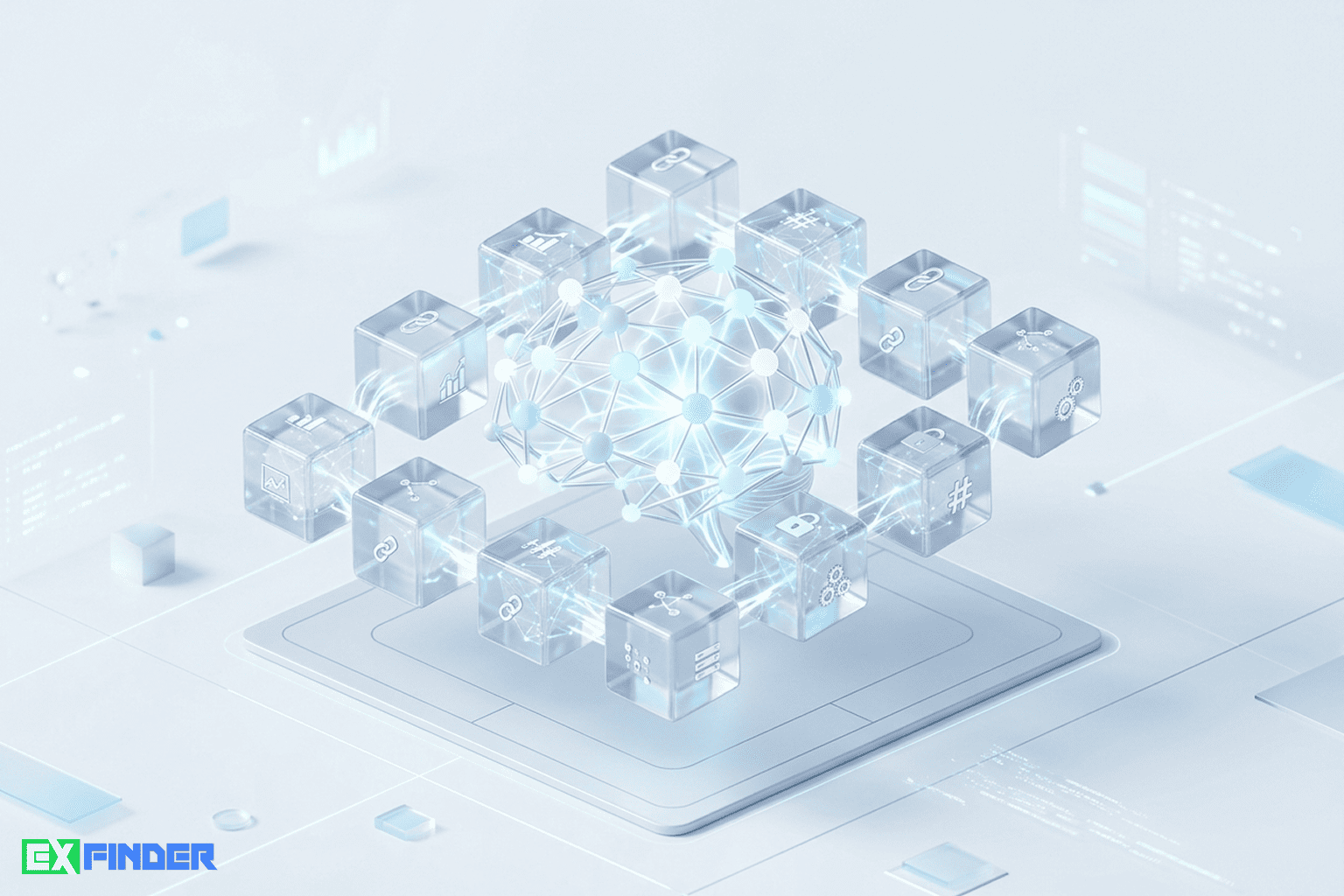
Artificial Intelligence (AI) and blockchain are diametrically opposed yet fundamentally complementary technologies. AI provides intelligence, processing speed, automation of complex decision-making, and predictive analytics. However, it suffers from the "black box" problem, hallucination risks, data bias, and centralized control over compute infrastructure. Conversely, blockchain delivers trust, transparency, data immutability, verifiable provenance, and decentralized settlement, but remains computationally limited and slow for complex analytical tasks. The intersection of these two paradigms establishes a transformative technological foundation: ranging from decentralized compute infrastructure for AI model training to autonomous economic agents, intelligent smart contracts, and transparent, cryptographically verifiable data auditing.
1. Introduction: Technological Paradox and the Convergence of Two Giants
The technological landscape of the current decade is largely defined by two dominating vectors: Artificial Intelligence (AI) and Distributed Ledger Technology (DLT / Blockchain). At first glance, they appear to be fundamentally contrasting systems. AI strives for high speed, massive scale, processing vast amounts of unstructured information, and making probabilistic inferences. Blockchain, on the other hand, relies on deterministic algorithms, cryptographic rigidity, immutable history, and deliberate trade-offs in processing speed to achieve absolute, consensus-based finality.
Yet, it is precisely this fundamental divergence that makes their convergence inevitable. AI requires a secure, tamper-proof, and decentralized data foundation to prevent dataset manipulation, model poisoning, and corporate monopolies over computational infrastructure. Simultaneously, blockchain networks require intelligence to automate smart contracts, enhance on-chain analytics, optimize gas efficiency, and dramatically improve the user experience (UX). Blending AI and blockchain transforms modern digital architecture, constructing the foundation for a truly decentralized, intelligent Web3 ecosystem.
2. Why AI Needs Blockchain: Solving Systemic Artificial Intelligence Bottlenecks
Modern Large Language Models (LLMs) and deep neural networks face several structural crises that cannot be resolved within traditional, centralized Web2 architectures. Distributed ledgers offer robust solutions to these core vulnerabilities.
2.1. Data Provenance and Integrity Verification
The outputs of any AI model depend directly on the quality and integrity of its training corpus ("Garbage In, Garbage Out"). In centralized corporate environments, training datasets can be silently modified, contaminated, or deliberately poisoned. By recording cryptographic hash proofs of training datasets and their version tags directly on a blockchain, developers establish an immutable audit trail. This enables auditors and users to independently verify that a given model was trained on genuine, unaltered data without hidden backdoors or bias insertions.
2.2. Demystifying the "Black Box" Problem (Explainable AI - XAI)
Decision-making within deep neural networks often remains opaque, even to their original creators. When an AI system makes critical decisions regarding credit scoring, medical diagnostics, or automated transaction halts, an auditable trail becomes mandatory. Logging intermediate execution steps or model inferences onto a decentralized ledger via Zero-Knowledge Proofs (ZKPs) creates an immutable, verifiable audit trail without exposing the proprietary weights or confidential inputs of the model itself.
2.3. Countering Disinformation, Deepfakes, and Intellectual Property Theft
Generative AI has made the creation of hyper-realistic deepfakes and synthetic media virtually frictionless. Blockchain technology addresses this crisis by implementing cryptographic digital content attestation. When physical cameras or media outlets sign original content using private keys registered on-chain, any AI-generated forgery can be instantly detected through the absence of a valid, verifiable cryptographic signature.
2.4. Decentralization of Computational Resources (DePIN)
Training state-of-the-art neural networks requires immense GPU compute clusters, the supply of which is currently monopolized by a handful of hyperscale cloud providers. Decentralized Physical Infrastructure Networks (DePIN), such as Render, Akash, and Bittensor, aggregate unused GPU capacity worldwide into a global, peer-to-peer compute grid. Blockchain acts as the trustless coordination layer and instant settlement rails for paying compute providers via microtransactions.
3. Why Blockchain Needs AI: Overcoming the Limitations of Distributed Systems
Integrating artificial intelligence into blockchain protocols solves fundamental limitations inherent to decentralized networks: user experience complexity, smart contract vulnerabilities, and inefficient data parsing.
3.1. Automated Smart Contract Code Auditing
Smart contract exploits result in the loss of hundreds of millions of dollars annually across the DeFi space. Traditional manual code auditing is slow, expensive, and prone to human oversight. Machine learning models trained on vast repositories of historic smart contract vulnerabilities and exploit payloads can perform static and dynamic code analysis (Solidity, Rust, Vyper) in seconds, identifying critical flaws like reentrancy attacks, integer overflows, or oracle manipulation before deployment to mainnet.
3.2. Advanced On-Chain Analytics and Pattern Recognition
Raw blockchain ledgers consist of vast, unstructured transaction logs that are difficult for human analysts to interpret in real time. AI models automatically parse and structure on-chain activity, classifying wallet behavior, detecting insider trading patterns, performing Anti-Money Laundering (AML) risk scoring, and clustering addresses instantly to deliver actionable intelligence.
3.3. Personalization and User Experience (UX) Enhancement
Navigating cryptographic wallets, gas limit settings, session keys, and complex transaction approvals represents the single largest barrier to mass Web3 adoption. AI assistants integrated into non-custodial wallets allow users to execute transactions using natural language. Instead of manually adjusting slippage tolerances and signing complex hexadecimal strings, a user simply states: "Swap $100 for ETH at the lowest fee," while the AI agent orchestrates the underlying smart contract calls behind the scenes.
3.4. Consensus Optimization and Resource Allocation
AI algorithms can be applied directly at the protocol level to predict network congestion, dynamically adjust block sizes, optimize peer-to-peer (P2P) node routing, and manage validator staking parameters, reducing overall network latency and energy consumption.
4. Key Technological Architectures at the Intersection of AI and Blockchain
The deep convergence of AI and DLT operates across several specialized architectural layers, each giving birth to novel software primitives.
4.1. zkML (Zero-Knowledge Machine Learning)
zkML represents a groundbreaking cryptographic advance. It allows an AI provider to cryptographically prove that a specific inference result was generated by running specific input data through a specific neural network model **without revealing the underlying input data or model weights**. This enables privacy-preserving AI applications in healthcare, credit scoring, and institutional finance where exposing raw sensitive data is strictly prohibited by law.
4.2. opML (Optimistic Machine Learning)
Because generating zero-knowledge proofs for multi-billion parameter LLMs is computationally intensive, opML provides an alternative execution model inspired by Optimistic Rollups. Inference results are assumed correct by default, but any participant can challenge a result on-chain within a designated dispute window by submitting a fault proof. This significantly lowers computational costs and enables the execution of massive models like GPT-4 within Web3 workflows.
4.3. Decentralized Federated Learning
Federated learning enables training a global AI model across thousands of edge devices (smartphones, local servers) without transferring raw data to a central cloud server. Blockchain coordinates this distributed process: registering model gradient updates, guarding against malicious model poisoning, and automatically distributing token incentives to edge device operators who contribute compute and data.
5. Comparative Analysis: Centralized AI vs. Decentralized Web3 AI
The table below highlights the operational and architectural differences between traditional Web2 AI paradigms and decentralized Web3 AI implementations:
| Feature / Dimension | Centralized AI (Web2 / Big Tech) | Decentralized AI (Web3 + Blockchain) |
|---|---|---|
| Data Ownership & Storage | Proprietary corporate silos (OpenAI, Google) | Decentralized storage (IPFS, Arweave) with cryptographic proof |
| Training Data Auditability | Opaque ("Black Box") | Transparent through on-chain dataset hash attestations |
| Computational Infrastructure | Monopolized hyperscale data centers (AWS, Azure) | Distributed peer-to-peer GPU networks (DePIN: Bittensor, Render) |
| Inference Verification | Requires complete trust in the service provider | Cryptographically verifiable via zkML or opML proofs |
| Monetization & Settlement | Traditional monthly credit card subscriptions | Granular microtransactions, smart contracts, token rewards |
| Access & Censorship Resistance | Subject to geo-blocking, account bans, or policy shifts | Permissionless access open to any human user or autonomous agent |
6. Autonomous Economic Agents (AI Agents): The Next Frontier in Finance
Perhaps the most powerful manifestation of AI-blockchain synergy is the rise of **Autonomous Economic Agents (AEAs)**. An autonomous AI agent is a software entity capable of perceiving its environment, making independent decisions, formulating goals, and executing complex workflows without human intervention.
However, for an AI agent to operate as an independent economic actor, it requires financial infrastructure and legal-equivalent settlement capabilities. Traditional banking systems cannot issue bank accounts, process credit cards, or complete KYC checks for automated software scripts. Blockchain solves this barrier entirely:
- Self-Sovereign Cryptographic Wallets: An AI agent holds its own private keys, enabling it to send, hold, and receive digital assets completely autonomously.
- Programmable Contractual Execution: Agents can programmatically negotiate services, purchase compute power from DePIN networks, pay other AI agents for specialized sub-tasks, and manage capital within DeFi protocols.
- Micro-Payments and Pay-Per-Inference: Through Layer-2 scaling solutions and payment channels, agents settle fractions of a cent per API request or data stream in real time without intermediary transaction fees.
💡 Practical Example of an Autonomous Agent Workflow: An AI agent continuously monitors global 3D rendering demand. It autonomously hires spare GPU compute capacity via the Akash DePIN protocol, purchases raw 3D model files on a decentralized marketplace, renders high-fidelity assets, lists them for sale on OpenSea, and automatically redistributes the generated profits back to its tokenized backers via smart contracts.
7. Real-World Use Cases of AI and Blockchain Synergy
The intersection of these technologies is already transforming critical sectors of the digital economy:
7.1. Decentralized Finance 2.0 (DeFAI)
In DeFi, AI-driven asset management vaults dynamically optimize yield farming strategies, automatically rebalancing liquidity across Uniswap, Aave, and Curve based on real-time market volatility, gas fees, and smart contract risk scores. This eliminates human latency and minimizes emotional trading mistakes.
7.2. Intelligent Supply Chain Management
Combining IoT hardware sensors, AI, and blockchain automates global logistics. IoT sensors log temperature and location data, an AI model continuously evaluates whether shipment conditions meet regulatory standards, and an on-chain smart contract automatically releases escrow payments upon verified delivery without manual paperwork.
7.3. Decentralized Healthcare and Medical Research
AI models analyze anonymized medical records globally to accelerate drug discovery. Through zkML and decentralized federated learning on blockchain networks, patients maintain total ownership over their private health data while earning token rewards from pharmaceutical researchers in exchange for granting cryptographically secure access.
7.4. AI-Driven Decentralized Autonomous Organizations (AI-DAOs)
Traditional DAOs suffer from low voter turnout and sluggish proposal execution. Integrating AI agents into DAO governance structures enables automated proposal risk analysis, financial treasury modeling, and delegated execution of routine administrative tasks based on parameters established by token holders.
8. Risks, Engineering Challenges, and Technological Barriers
Despite its immense promise, the fusion of AI and blockchain faces significant engineering and economic hurdles that must be addressed before mainstream enterprise adoption:
⚠️ Primary Engineering and Operational Challenges:
- High Computational Overhead of zkML: Generating zero-knowledge proofs for neural networks with billions of parameters can require up to 1,000x more compute power than running the raw inference itself.
- The On-Chain Integrity Dilemma ("Garbage In, Blockchain Out"): Blockchain guarantees that recorded data cannot be altered, but it cannot verify if the AI model's initial inference was inherently flawed or biased.
- AI Hallucinations in Financial Execution: If an autonomous agent with direct custody over capital hallucinates or encounters an edge-case error during smart contract interaction, capital losses can be immediate and irreversible.
- Regulatory and Liability Ambiguities: Current legal frameworks lack clear definitions for actions taken by autonomous software agents (e.g., who bears legal liability if an AI agent executes an unauthorized or non-compliant transaction?).
9. Future Outlook: The Rise of the Agentic Web
Over the next 5 to 10 years, we will witness the emergence of the **Agentic Web**. This paradigm shift represents an internet environment where the majority of online interactions, economic trades, and data exchanges occur autonomously between AI agents utilizing blockchain as their native monetary, legal, and identity rails.
Blockchain will serve as the machine-to-machine (M2M) economic layer. In this future, users will no longer manually manage individual API subscriptions, negotiate service agreements, or verify data authenticity. Instead, specialized AI agents operating under zero-knowledge cryptographic frameworks will execute these actions seamlessly in the background, maximizing efficiency while preserving human privacy.
10. Frequently Asked Questions (FAQ)
Can an AI neural network run directly inside an Ethereum smart contract?
Currently, executing complex neural networks directly within the Ethereum Virtual Machine (EVM) is impossible due to strict gas limits and compute constraints. Instead, heavy computations are performed off-chain via decentralized compute networks, while only a lightweight cryptographic proof (zkML/opML) is submitted on-chain for rapid verification.
Why is Decentralized AI superior to centralized models like ChatGPT or Claude?
Decentralized AI ensures that your private prompts and business data cannot be harvested for secret model retraining, protects models from arbitrary censorship or regional bans, and provides cryptographic proof that the output has not been altered by a central authority.
How does blockchain help combat AI-generated deepfakes?
Blockchain enables digital content attestation. Media capture devices and content creators sign original media with private keys at the moment of creation. Verification tools can instantly compare any video or image against its on-chain cryptographic registry; if the signature is missing or altered, the content is flagged as unverified or synthetic.
What is DePIN and how does it relate to Artificial Intelligence?
DePIN (Decentralized Physical Infrastructure Networks) connects hardware owners offering spare GPU compute power directly with AI developers who need model training resources. Blockchain orchestrates these peer-to-peer hardware networks, reducing compute costs significantly compared to centralized cloud monopolies.
11. Conclusion
The fusion of artificial intelligence and blockchain technology represents far more than a passing trend—it is a foundational blueprint for building a secure, transparent, and hyper-efficient digital infrastructure. AI endows decentralized ledger systems with intelligence, adaptability, and user-centric automation, while blockchain equips artificial intelligence with verifiable trust, tamper-proof data provenance, and true economic autonomy.
As these two paradigm-shifting technologies continue to converge, they establish the framework for a decentralized machine-to-machine economy, where trust is guaranteed by cryptography and performance is driven by intelligence.
Want to stay ahead of cutting-edge tech trends and leverage the most efficient tools in the crypto ecosystem? Explore our intelligent monitoring platform to find verified exchanges with optimal rates and seamless execution today!