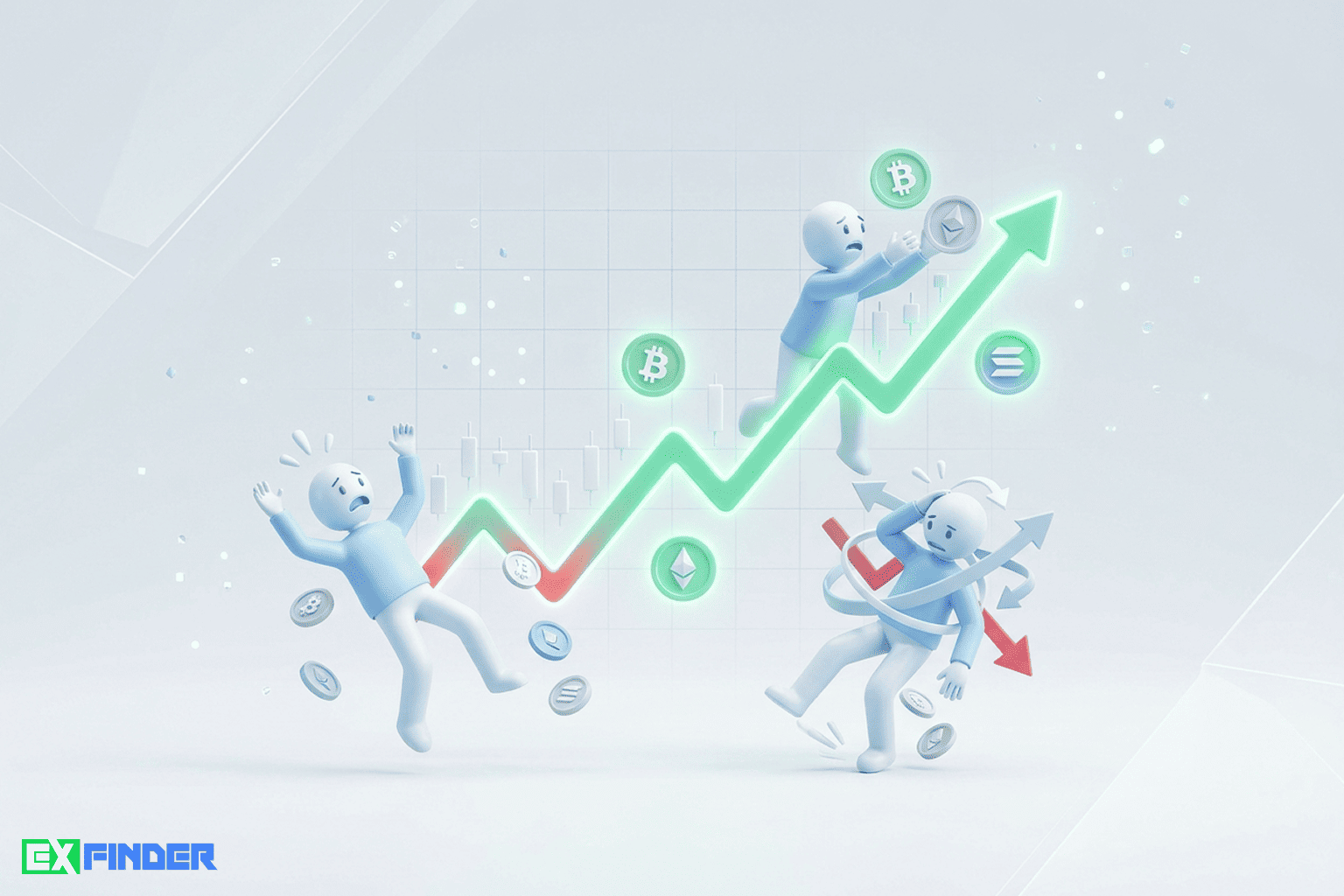
An expanding ("bullish") cryptocurrency market creates an illusion of easy wealth, yet over 80–90% of retail investors and day traders end up suffering net losses or entirely wiping out their capital during a massive rally in Bitcoin and altcoins. The core causes of this paradox lie in psychological traps (Fear of Missing Out — FOMO, social envy, cognitive overconfidence), lack of structured profit-taking frameworks, chaotic capital rotation into unvetted tokens, excessive leverage usage triggering cascade liquidations, and hidden fee friction during fiat-to-crypto entry and exit points.
1. Introduction: The Global Bull Run Paradox
The central paradox of the cryptocurrency market is that an explosive growth phase (a Bull Market or Bull Run) is frequently the most dangerous environment for individual investors. When asset charts show non-stop green candles and total market capitalization doubles or triples, common logic suggests every participant should profit easily. However, empirical on-chain analytics and exchange liquidity reports reveal a starkly contrasting reality: account liquidations, capital erosion, and realized financial losses reach historical peaks precisely during the height of a bull market.
The root cause of this phenomenon lies in shifting market dynamics. During a bear market, only experienced traders, institutional players, and disciplined allocators remain active, operating with caution and structured risk management. As prices surge, the market becomes flooded with millions of retail participants driven by emotion. Because trading is a zero-sum game (and negative-sum when accounting for protocol and exchange fees), profits captured by market makers and institutional desks are generated from systemic errors committed by an inexperienced retail majority.
2. Psychological Destructors: How Emotions Destroy Portfolios
Behavioral economics demonstrates that investor rationality breaks down rapidly under the influence of two primary emotions: fear and greed. In a rising market environment, these emotional responses reach extreme levels.
2.1. Fear of Missing Out (FOMO)
FOMO is the primary engine of capital destruction during a bull run. When an investor watches a token double or triple within hours, a psychological impulse triggers an urgent sense of missed opportunity. Instead of evaluating fundamental valuation metrics, retail traders buy heavily at local price tops ("at the high"). When normal market pullbacks follow, the portfolio incurs immediate unrealized drawdowns, triggering panic.
2.2. Social Envy and Performance Comparison
During market surges, social media channels become saturated with screenshots of massive gains, luxury purchases, and overnight wealth stories. This creates immense psychological pressure: a solid 20% or 30% gain feels inadequate by comparison, prompting investors to abandon conservative assets (Bitcoin, Ethereum) in favor of hyper-volatile, highly manipulative altcoins.
2.3. The Illusion of Skill in a Rising Market
When virtually every token appreciates, nearly any random purchase yields positive returns. This induces a dangerous cognitive bias: investors attribute market-wide tide increases to personal trading talent. Consequently, they expand risk parameters, ignore position-sizing rules, and introduce leverage or external debt, leaving them vulnerable to catastrophic losses when market conditions pivot.
2.4. Panic Selling on Local Retracements
Bull markets do not move in a straight line; intraday corrections of 20% to 30% are common. Unprepared participants who bought at price peaks often panic during sharp pullbacks, selling assets at a loss out of fear of total liquidation. Frequently, prices rebound shortly thereafter, resuming their upward trend toward new all-time highs.
3. Structural and Strategic Errors in Capital Management
Even when selecting solid projects, most market participants lose capital due to poor discipline and flawed asset allocation strategies.
3.1. Chaotic Capital Rotation ("Peak Chasing")
A trader holds Asset A. While Asset A consolidates sideways, Asset B surges 50%. Impatient, the trader sells Asset A at a minor loss or breakeven to chase Asset B at its peak. Shortly after, Asset B enters a correction phase while Asset A begins its deferred rally. Repeating this cycle multiple times can destroy most of an account's equity, even though both assets ultimately rose over a broader timeframe.
3.2. Lack of a Structured Take-Profit Strategy
Many investors know when to enter a position but lack a clear plan for exiting. Paper gains are often treated as realized wealth. Investors hold out for unrealistic price targets ($100,000, $500,000, or $1,000,000) without de-risking their initial principal. When the bull market abruptly ends, accumulated unrealized profits evaporate, turning gains into long-term losses.
3.3. Capital Allocation into Unvetted Assets (Memecoins & Low-Liquidity Tokens)
Market rallies trigger a flood of speculative tokens lacking fundamental utility. Driven by aggressive marketing and temporary price pumps, retail investors deposit funds into low-liquidity projects where early insiders dump their holdings onto incoming buyers (Rug Pulls).
3.4. The Misapplication of Averaging Down
Investors frequently add to losing positions in declining altcoins hoping for a quick rebound (Averaging Down). If the asset is fundamentally flawed or abandoned by its team, this practice compounds losses, tying up capital in non-performing assets indefinitely.
4. The Leverage and Liquidation Trap
Margin trading serves as the primary mechanism through which centralized exchanges and market makers extract liquidity from retail traders during a bull run.
As asset prices climb, spot returns can feel too slow to retail market participants. To accelerate gains, traders open leveraged long positions at 10x, 20x, 50x, or 100x multiplier levels. However, crypto markets are characterized by extreme volatility events known as "liquidation cascades." Institutional desks and market makers often push prices down by 5% to 10% within minutes to trigger clustered stop-loss orders and liquidate over-leveraged longs before prices resume their broader upward trajectory.
Consequently, while a trader may correctly predict the macro direction of the market, their leveraged position is wiped out during a transient volatility spike, resulting in total loss of margin balance.
5. Comparative Analysis: HODL Strategy vs. Active Day Trading
The table below contrasts two distinct operational approaches over a 12-month bull market cycle:
| Dimension / Metric | Active Retail Trader (Speculator) | Passive Investor (HODL + DCA Framework) |
|---|---|---|
| Core Motivation | Chasing rapid multi-fold gains, driven by FOMO | Capital preservation and disciplined growth |
| Transaction Frequency | High (Multiple trades per day or week) | Low (Scheduled periodic buys via DCA) |
| Leverage Utilization | Frequent (5x to 50x futures contracts) | None (Spot market purchases only) |
| Volatility Exposure | Extreme (Risk of total liquidation) | Moderate (Temporary paper drawdown) |
| Fee Friction & Spread Costs | Heavy (Trading fees, funding rates, spreads) | Minimal (Occasional conversion fees) |
| Psychological Stress | High (Emotional fatigue, anxiety) | Low (Rule-based automated process) |
| Historical Probability of Success | 85–90% Net Loss or Account Wipeout | 80–90% Net Portfolio Appreciation |
6. Invisible Capital Friction: Exchange Rates and Fiat On/Off-Ramps
Beyond trading losses on exchanges, a significant portion of an investor's capital erodes during fiat onboarding or cash-out phases via inefficient or unvetted exchange providers.
During peak bull market activity, underlying blockchain networks (Ethereum, Bitcoin) experience severe congestion, causing network gas fees to spike. Inexperienced users frequently make costly operational errors:
- Trading at Hidden Spreads: Unregulated fiat-to-crypto exchanges often embed hidden spreads (up to 5–8%) during high-volatility events.
- Ignoring Network Transaction Fees: Executing small transactions on expensive layer-1 chains (ERC-20) where gas fees exceed the transfer amount.
- Using Unverified Exchange Platforms: Risking funds on dubious platforms or phishing sites with poor liquidity, leading to frozen transactions under vague compliance checks.
- Suboptimal Payment Routing: Converting assets through multiple intermediaries, incurring compound conversion charges.
💡 Key Takeaway on Reducing Slippage and Fees: To protect net returns, investors should utilize independent crypto exchange monitoring platforms. These services calculate the true net yield (Net Amount) by accounting for live network gas fees, payment gateway margins, and order book depth in real time.
7. Market Maker Dynamics and Liquidity Extraction
A bull market provides optimal conditions for institutional players and whales to execute structured liquidity extraction tactics against retail participants:
7.1. Stop-Loss Liquidity Sweeps
Large market participants identify clusters of retail stop-loss orders below key technical support levels. By executing large sell orders, they drive price down to trigger these stops, filling their own buy orders at discounted prices before allowing the market to recover.
7.2. Pump-and-Dump Schemes
Low-liquidity tokens are aggressively hyped and bought up to inflate price charts. Once retail investors enter out of FOMO, early holders dump their large inventories into the buying volume, leaving late buyers with illiquid tokens.
7.3. Exit Liquidity on Media News Events
Major positive news announcements are frequently timed for the peak of a price movement, providing large holders with the exit liquidity needed to realize profits on their positions without crashing the market price immediately.
8. Practical Risk Frameworks for Capital Preservation
To join the minority of market participants who retain profits through a full market cycle, investors should implement strict operational guidelines:
⚠️ Essential Rules for Surviving a Bull Market:
- Pre-Define Exit Strategies: Establish clear take-profit targets and stop-loss levels before executing any buy order.
- Avoid High Financial Leverage: Trade primarily on the spot market or limit leverage to low multiples (2x–3x) with strict risk limits.
- Withdraw Initial Capital: When an investment doubles, sell enough to recoup your original principal into stablecoins or fiat.
- Utilize Dollar-Cost Averaging (DCA): Accumulate and distribute assets systematically over time rather than deploying capital in single lump sums.
- Audit Exchange Routes: Use trusted monitoring platforms to select optimal conversion pathways and minimize hidden fee drag.
9. Frequently Asked Questions (FAQ)
Why do I lose money even when buying top-10 cryptocurrencies?
Top-tier cryptocurrencies still experience sharp intraday drawdowns of 20% to 40%. Buying at local peaks and selling out of fear during short-term pullbacks locks in real losses before the broader uptrend resumes.
Is it better to hold Bitcoin or trade altcoins during a Bull Run?
Bitcoin carries lower volatility and reduced systemic risk. While altcoins offer higher potential upside, their downside risk is significantly higher. Maintaining a majority portfolio allocation (60–70%) in established assets like BTC and ETH provides a safer baseline.
What are the signs of an impending bull market top?
Common indicators include mainstream media euphoria, widespread discussion of crypto among non-investors, parabolic rises in low-utility meme tokens, dropping Bitcoin dominance, and extreme funding rates across futures exchanges.
How can I avoid excessive fees when taking profits into fiat?
Avoid using unfamiliar platforms without rate verification. Use independent monitoring tools that calculate total execution costs, including network gas fees, payment gateway margins, and actual net payout amounts.
10. Conclusion
Financial losses during a cryptocurrency bull market are rarely accidental; they are the predictable result of behavioral biases, poor capital management, and structural market mechanics. The crypto market systematically rewards disciplined, patient, and analytical participants while reallocating capital away from emotional and over-leveraged traders.
Successfully navigating a bull cycle requires a clear investment thesis, strict risk management protocols, resistance to emotional impulses, and careful control over every transaction layer—from order placement to selecting cost-effective fiat exchange routes.
Lock in your profits safely and efficiently! Use our intelligent crypto exchange monitoring platform to compare real-time rates, minimize hidden fees, and access verified exchange providers today!