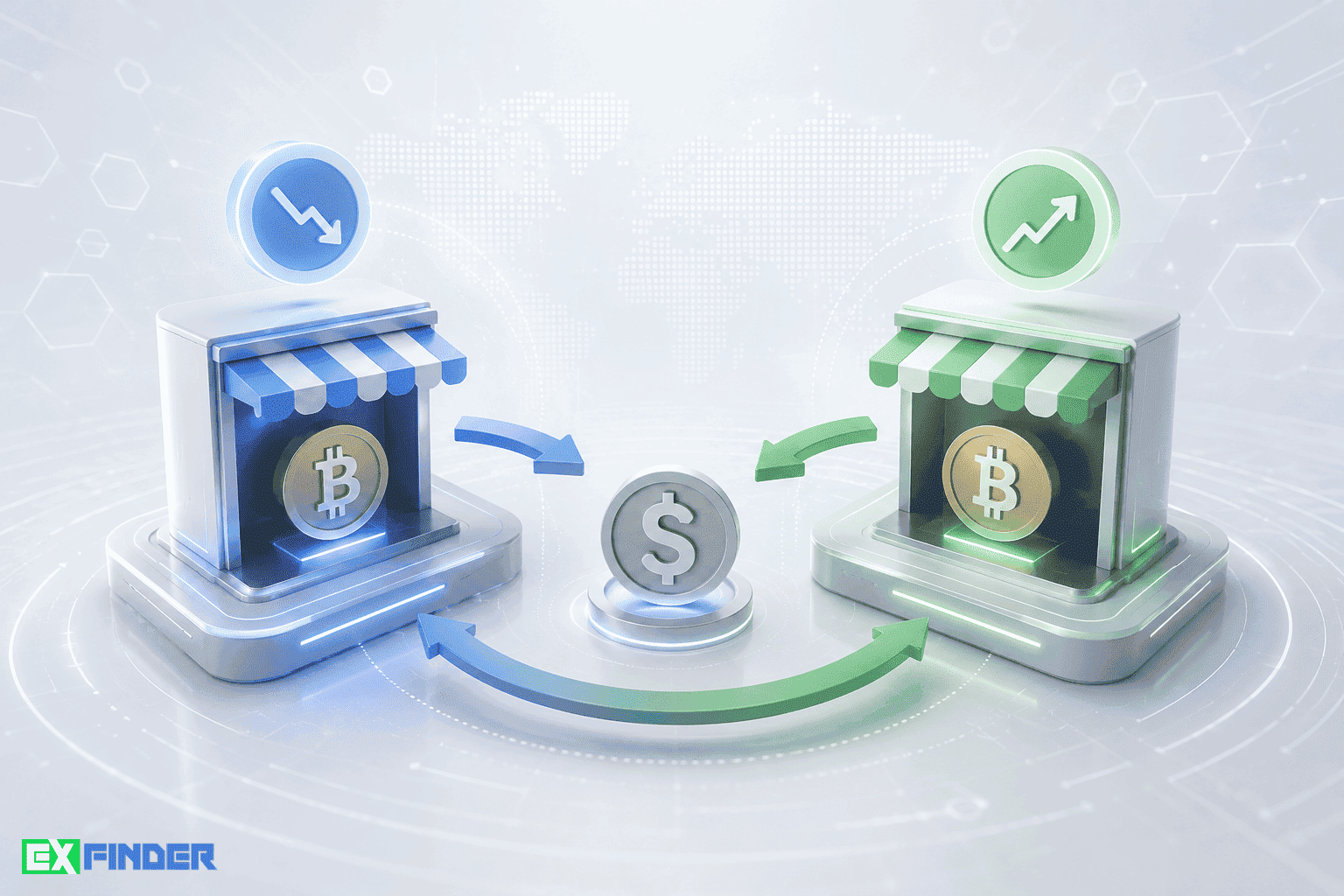
Arbitrage is a way to profit from the fact that the same asset may have different prices in different places. A person buys the asset where it is cheaper and sells it where it is more expensive. In cryptocurrency, this idea is especially noticeable because Bitcoin, Ethereum, USDT, and many other digital assets trade on hundreds of exchanges, P2P platforms, and online crypto exchangers at the same time.
At first, the strategy sounds almost too easy: find a price difference, complete two transactions, and keep the profit. In reality, however, there are several steps between spotting a price gap and actually earning money from it. Trading fees, withdrawal fees, blockchain congestion, liquidity, limits, verification requirements, and sudden market movements can all reduce or completely eliminate the expected return.
This guide explains what arbitrage is in simple words, why price differences appear, which types of crypto arbitrage are most common, how to calculate a realistic result, and what mistakes beginners should avoid.
What arbitrage means without complicated terms
The word arbitrage describes a strategy in which a market participant uses a price difference for the same or a very similar asset across different platforms.
Imagine that a product costs $1,000 in one city but buyers in another city are willing to pay $1,100 for it. In theory, you could buy the product in the cheaper location, move it, and sell it in the more expensive one. The $100 difference would be the gross return. After paying for delivery, fees, and other costs, the amount that remains would be the actual profit.
In cryptocurrency, the product is replaced by a digital asset. Bitcoin may be slightly cheaper on one exchange than on another. USDT may have different rates at two crypto exchange services. On a P2P marketplace, one payment method may be valued more highly than another. Each of these situations can create a potential arbitrage opportunity.
In short: arbitrage is not about predicting where the market will move. It is about using a price difference that already exists.
A traditional trader may buy Bitcoin because they believe its price will rise next week or next year. An arbitrage trader usually tries to buy cheaper and sell higher at nearly the same time. The focus is not on a long-term forecast but on a specific price gap between platforms.
Why the same asset can have different prices
Many beginners assume that Bitcoin or USDT must have one universal, official price. In reality, there is no single global marketplace where every trade happens. Each exchange, exchanger, and P2P platform forms its own rate based on user orders, reserves, and local demand.
Different supply and demand
One platform may temporarily have more buyers than sellers. This pushes the price upward. Another platform may have many users trying to sell the same asset, which can push the price down.
Different liquidity
Liquidity shows how easily an asset can be bought or sold without causing a large price movement. On a major exchange with millions of users, the gap between buying and selling prices is often small. On a smaller platform, even one large order can noticeably move the market.
Regional differences
Banking rules, payment methods, access to international transfers, and demand for stablecoins differ from country to country. Because of this, USDT may trade at a premium in a region where access to foreign currency is limited or where demand for digital dollars is especially high.
Different update speeds
Some platforms refresh prices almost instantly, while others may react more slowly. During fast market movements, delayed quotes can create a temporary gap. Such opportunities often disappear within seconds.
Fees and business models
A crypto exchanger may show an attractive headline rate but charge a fixed fee later. Another service may include its margin directly in the displayed rate. This is why comparing only the number on the homepage is not enough. The final amount the user receives is what really matters.
A simple crypto arbitrage example
Suppose Bitcoin trades for $100,000 on Exchange A and can be sold for $101,000 on Exchange B. The visible price difference is $1,000, or 1%.
If a trader buys 0.1 BTC on Exchange A, the purchase costs $10,000. If the trader then sells 0.1 BTC on Exchange B at a price of $101,000, the sale brings in $10,100. The gross result is $100.
Now the costs must be included. Exchange A may charge 0.1% for the purchase. The blockchain network may require a transfer fee. Exchange B may charge 0.1% for the sale. In addition, the price can change while the Bitcoin is being transferred. After all expenses, the original $100 difference may shrink to $50, $20, or even become negative.
A more realistic formula looks like this:
Net result = sale revenue − purchase cost − trading fees − network fees − deposit and withdrawal costs − other charges.
This is the main reason why a visible spread does not automatically mean guaranteed profit. An arbitrage opportunity is only real if a positive amount remains after every cost is included.
Main types of arbitrage
Inter-exchange arbitrage
This is the best-known version. A trader buys an asset on the exchange where it is cheaper and sells it on the exchange where it is more expensive. This approach is often called crypto exchange arbitrage.
The main disadvantage is transfer time. If the trader first buys a coin and then sends it to another exchange, the price may change before the transaction is confirmed. For this reason, experienced participants sometimes keep funds on both platforms. They buy on one exchange and sell on the other at nearly the same moment, then rebalance their funds later.
Arbitrage between crypto exchange services
Online crypto exchangers may offer different rates for the same pair, such as UAH to USDT or Bitcoin to a bank card. The user's task is to find one service with a favorable buying rate and another with a favorable selling rate.
In this case, reserves, minimum amounts, payment methods, processing speed, and reputation are especially important. An unusually attractive rate on an unknown website may be a trap rather than a genuine opportunity.
P2P arbitrage
P2P means peer-to-peer. On these marketplaces, users publish their own offers to buy or sell cryptocurrency. Rates depend on the bank, currency, payment method, limits, and competition between merchants.
P2P arbitrage may involve buying USDT more cheaply through one payment method and selling it at a higher rate through another. However, this format also adds human factors: payment delays, incorrect details, disputes, bank restrictions, and the risk of dealing with suspicious counterparties.
Triangular arbitrage
Triangular arbitrage takes place within one exchange. Instead of moving funds between platforms, the trader uses a pricing mismatch between three trading pairs.
For example, the trader starts with USDT, buys Bitcoin, exchanges Bitcoin for Ethereum, and then sells Ethereum back for USDT. If the final USDT balance is higher than the starting balance, the cycle was profitable.
This form of arbitrage usually requires very fast calculations, which is why algorithms often perform it. A human trader may not complete all three transactions before the prices change.
Statistical arbitrage
This is a more advanced strategy based on mathematical models. An algorithm looks for assets that historically move in similar ways and opens positions when that relationship temporarily breaks down.
Unlike classic arbitrage, statistical models do not always capture a guaranteed price difference. They work with probabilities, so the risk is higher.
International arbitrage
Cryptocurrency can be valued differently in different countries because of regulation, banking infrastructure, payment restrictions, or local demand. In theory, a participant can buy an asset in a region where it is cheaper and sell it where it trades at a premium.
International transactions may involve banking reviews, currency controls, tax rules, and identity verification requirements. This is why legal compliance is especially important in this type of arbitrage.
Comparison of crypto arbitrage types
| Type | How it works | Main advantage | Main risk |
|---|---|---|---|
| Inter-exchange | Buying on one exchange and selling on another | Easy to understand | Transfer delays and price changes |
| Between exchangers | Using rate differences between online services | Many pairs and payment methods | Platform reliability and hidden terms |
| P2P | Buying and selling through user offers | Flexible payment options | Human factors and bank restrictions |
| Triangular | Exchanging through three pairs on one platform | No transfer between exchanges | The opportunity disappears quickly |
| International | Using regional price differences | Potentially larger spreads | Regulatory and tax complexity |
Fees that must be included
The most common beginner mistake is to focus only on the visible price gap. If an asset is cheaper by 0.8% on one platform, that does not mean the trader will earn 0.8%.
Trading fees. Exchanges charge for order execution. The rate may differ for maker and taker orders.
Deposit or withdrawal fees. Some platforms offer free deposits but charge a fixed amount for withdrawals.
Blockchain network fees. Transferring Bitcoin, Ethereum, or USDT requires payment to the blockchain network. The amount depends on the network and current congestion.
Spread. This is the difference between the best available buying and selling prices. On low-liquidity markets, the spread can be significant.
Slippage. A large order may be filled at several price levels. The average execution price can be worse than the first price shown on the screen.
Banking and payment fees. These are especially relevant in P2P trading and transactions involving fiat currencies.
Before entering a trade, it is useful to calculate not only the expected return but also a scenario in which the price moves slightly against you. If a very small movement turns the deal into a loss, the safety margin may be too small.
Liquidity and market depth
A favorable price may be available only for a very small amount. For example, a trader may be able to buy $100 worth of USDT at a good rate, while the next $5,000 must be purchased at a worse price.
This is why arbitrage traders study the order book, which shows available buy and sell orders. The first price matters, but so does the total amount that can be executed without significant slippage.
Crypto exchange services also have limited reserves. A platform may display a good rate but only have enough liquidity for a small transaction. Large orders may receive a custom rate that is less favorable than the public one.
Main risks of arbitrage
Price movement during transfer
While a transaction is moving through the blockchain, the price gap can disappear. During volatile conditions, the asset may already trade lower on the second exchange by the time it arrives.
Deposit or withdrawal delays
An exchange may temporarily suspend a specific network. A crypto exchanger may process a request manually. A bank may delay a payment. Even a few minutes can completely change the outcome.
Using the wrong network
USDT exists on several networks, including Ethereum and Tron. Sending an asset to an incompatible network address can result in lost funds or a complicated recovery process.
Low liquidity
If the order book does not contain enough volume, the trade will execute at a worse average price. The opportunity may look profitable on the screen but produce a different real result.
Account freezes and compliance checks
Platforms may request proof of funds, documents, or additional verification. These are normal parts of AML and KYC procedures, but they can delay an operation.
Fraudulent services
An extremely favorable rate can be used to attract users to a fake website. Before transferring funds, check the domain, service history, reviews, contact information, and whether the listed reserves appear realistic.
Legal and tax consequences
Cryptocurrency transactions may create tax obligations. Users should also follow the rules of their bank and the laws of the country where they live.
Important: arbitrage is not risk-free. A visible spread can disappear before the operation is completed, and technical or legal restrictions may matter more than the rate itself.
How to find arbitrage opportunities
Manually comparing dozens of exchanges and hundreds of exchangers is difficult. By the time a user opens several websites, the rates may already have changed. This is why traders use specialized tools.
Crypto exchanger monitoring services
A monitoring platform collects rates, reserves, limits, and reviews in one place. A user can choose a pair such as UAH to USDT and see which services offer the most competitive conditions.
For arbitrage, two directions must be compared: where the asset can be bought more cheaply and where it can be sold at a higher price. Payment methods, blockchain networks, and minimum amounts must also match.
Exchange scanners
Arbitrage scanners analyze quotes from several exchanges and display possible price gaps. Some tools estimate trading fees automatically, but users should still verify withdrawal charges, network costs, and whether deposits are active.
APIs and trading bots
An API allows a program to receive prices without opening the website manually. A bot can monitor hundreds of pairs, calculate the net spread, and send an alert when the difference exceeds a selected threshold.
Fully automated systems can also execute trades. However, a coding error, missing risk limit, or API failure may lead to losses. Automation increases speed, but it does not remove the need for supervision.
A step-by-step checklist for evaluating an opportunity
Step 1. Choose the pair. For example, UAH to USDT, BTC to USDT, or ETH to USDT.
Step 2. Find the price gap. Compare the final buying and selling prices on different platforms.
Step 3. Verify liquidity. Make sure the required amount is actually available at the quoted price.
Step 4. Calculate every cost. Include trading, network, banking, and other fees.
Step 5. Check transfers. Deposits and withdrawals must be active, and both platforms must support the same network.
Step 6. Estimate the time. The longer the operation takes, the greater the risk that the price will change.
Step 7. Verify the platform. Review its reputation, rules, and verification requirements.
Step 8. Start with a test. A small transaction helps confirm the route, speed, and real fees.
How much can be earned from crypto arbitrage?
There is no universal answer. The result depends on the size of the spread, execution speed, capital, fees, and the number of available opportunities.
On large liquid exchanges, the differences are often very small. Professional traders may compensate by using larger volumes and automation. On less liquid markets, the spread can be wider, but delays, risks, and the chance that the quoted rate is available only for a small amount also increase.
It is useful to measure the result not only as a percentage but also in actual money. A trade with a 0.4% return may look attractive, but after fees and time spent, the amount may be insignificant. Increasing the order size without checking liquidity can also worsen the average execution price.
The key question is not “How large is the visible spread?” but “How much net profit can realistically be locked in after all costs and risks?”
Can you start without large capital?
Technically, yes. However, a small balance creates two limitations. First, fixed fees take up a larger percentage of the transaction. Second, even a good percentage return produces only a small amount of money.
For beginners, small amounts are useful mainly for learning. They help users understand deposits, withdrawals, blockchain networks, order types, and exchanger workflows. After several test cycles, it becomes easier to estimate real costs.
Borrowed funds or all available savings should not be used. Arbitrage may appear safer than directional trading, but operational and technical risks still exist.
Common beginner mistakes
Confusing the gross spread with profit. A 1% difference can disappear completely after fees.
Ignoring reserves. A good rate is useless if the service does not have enough of the required asset.
Ignoring network speed. A cheap transfer may take longer than the opportunity remains open.
Choosing an unknown website because of an unusually attractive rate. Security is more important than a few extra tenths of a percent.
Forgetting about limits. Minimum and maximum transaction sizes may make the route unavailable.
Sending funds through the wrong network. The token name may be the same while the technical standards are different.
Using market orders without checking depth. This increases the risk of slippage.
Having no exit plan. If a transfer is delayed or the price changes, the trader should already know what action to take.
How arbitrage differs from ordinary trading
Traditional trading often involves a prediction. A trader buys an asset because they expect the price to rise or opens a short position because they expect it to fall.
Arbitrage is based on a different idea: the gap already exists. The goal is to capture it before it disappears. This reduces dependence on the long-term direction of the market but increases the importance of speed, infrastructure, and precise calculations.
The boundary is not always perfectly clear. If a long period passes between the purchase and the sale, the operation begins to resemble speculation because the result increasingly depends on market movement.
Is arbitrage still relevant today?
Arbitrage remains part of the crypto market because platforms differ in liquidity, audience, region, and payment methods. However, simple opportunities are quickly detected by bots and professional market participants.
The more popular the pair and the larger the exchange, the faster prices tend to equalize. Modern arbitrage often requires automation, access to multiple platforms, pre-positioned capital, and reliable rate monitoring.
The largest gaps may appear during extreme volatility, technical disruptions, liquidity shortages, or sudden regional changes in demand. These moments can create opportunities, but they also increase risk.
FAQ
Is arbitrage the same as trading?
No. In traditional trading, a participant predicts future price movement. In arbitrage, the participant tries to use a price difference that already exists between platforms or pairs.
Is arbitrage profit guaranteed?
No. Even when a price gap exists, market movement, fees, delays, or low liquidity can remove the expected return.
Which cryptocurrencies are used most often?
Bitcoin, Ethereum, and stablecoins such as USDT are among the most common. The asset should be supported on both platforms and have sufficient liquidity.
Do I need special software?
For simple analysis, a rate monitoring service and calculator may be enough. For many exchanges, traders use scanners, APIs, and bots.
What is an arbitrage spread?
It is the difference between the buying price and the possible selling price. All costs must be subtracted from the spread to estimate the real result.
Why not simply transfer Bitcoin between exchanges?
You can, but the transfer takes time and requires a network fee. While the transaction is being confirmed, the price may change.
Is P2P arbitrage safe?
It has additional risks, including counterparty mistakes, payment delays, banking restrictions, and disputes. Platforms with escrow protection are generally safer.
How can I check a crypto exchanger?
Check the domain, operating history, reviews, reserves, contact details, exchange rules, and whether the service makes suspicious requests. Starting with a small test amount is also useful.
What minimum spread is required?
There is no universal number. The spread must exceed all fees, possible slippage, and a safety margin for price movement.
Do arbitrage profits create tax obligations?
This depends on the laws of the country and the user's legal status. A tax professional can help determine the correct treatment.
Conclusion
Arbitrage in simple words means buying an asset where it is cheaper and selling it where it is more expensive. In cryptocurrency, opportunities appear because exchanges, P2P markets, and online exchangers differ in demand, liquidity, regional conditions, update speed, and payment methods.
However, the visible price gap is only the beginning of the calculation. The real result depends on trading and network fees, reserves, limits, transfer speed, slippage, and platform reliability.
Crypto exchanger monitoring platforms, exchange scanners, and calculators can help users find opportunities more quickly. Still, every signal should be checked manually. The best arbitrage deal is not the one with the largest visible percentage, but the one that leaves a clear positive result after all costs and risks are taken into account.
Compare rates before every exchange.
Use a crypto exchange monitoring service to view current rates, reserves, limits, and reviews in one place. This can help you identify better offers more quickly and avoid suspicious services.