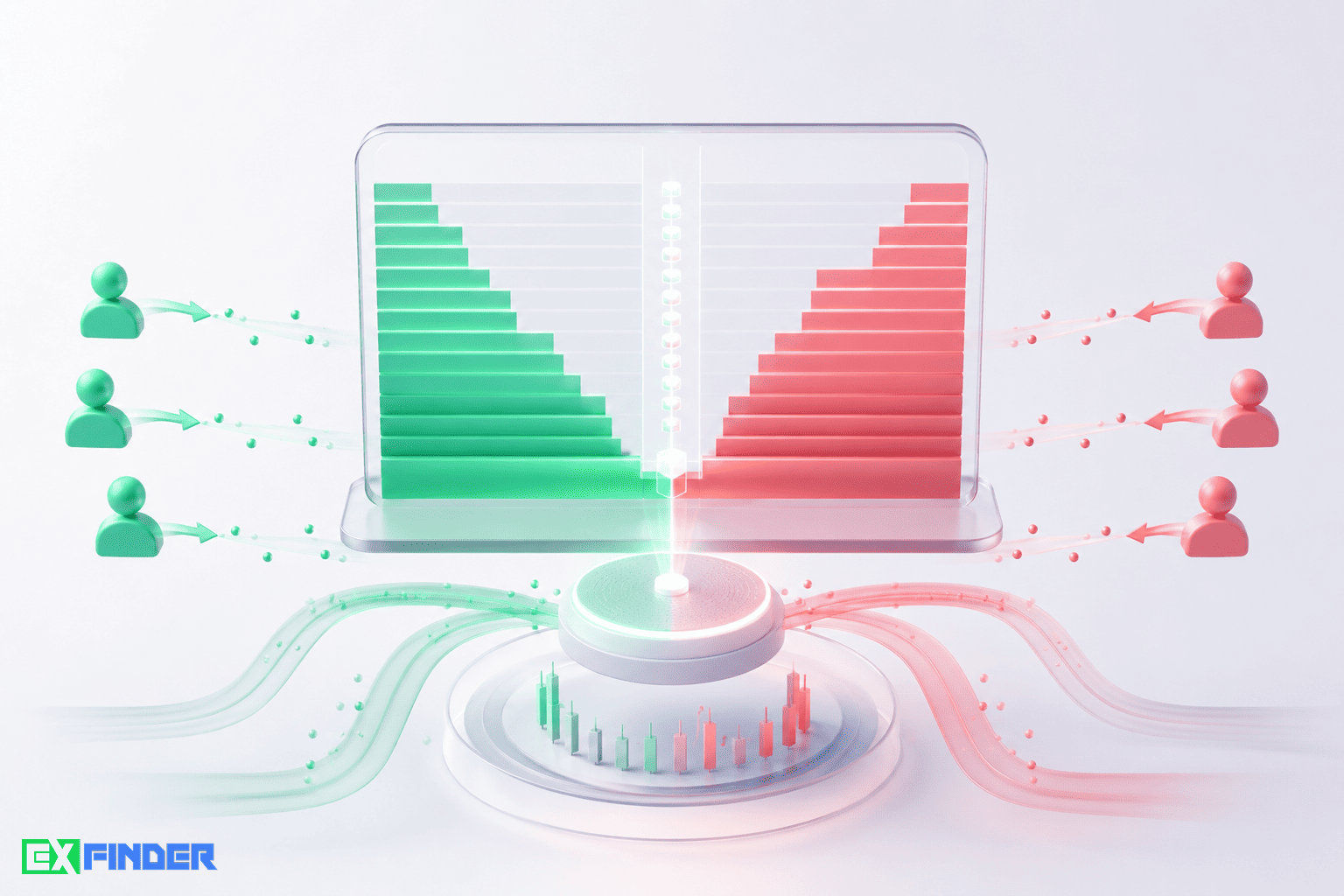
The order book is one of the core mechanisms of every exchange. It shows where participants are willing to buy and sell, where liquidity sits, how wide the spread is, and which levels may matter in the short term. But it is not a map of the future: orders can disappear, liquidity may be hidden, and price is shaped by buyers, sellers, market makers, algorithms, large traders, derivatives, and news.
What Is an Order Book in Simple Terms?
An order book is an electronic list of buy and sell orders for an asset. On a cryptocurrency exchange, it shows how much Bitcoin, Ethereum, or another asset participants are willing to buy or sell at specific prices.
The order book changes constantly. Users add, cancel, and execute orders, while algorithms may update quotes many times per second. It is therefore a live mechanism of price formation, not a static table.
The book has two sides: buy orders and sell orders. Buyers seek lower prices, sellers seek higher ones, and trades occur when their interests meet.
Key idea: the order book shows participants' intentions to trade at certain prices, but it does not guarantee that every visible order will remain in the book until execution.
Bid, Ask, and Spread
Bid
Bid is the best available price at which someone is willing to buy the asset. If the highest bid for Bitcoin is $100,000, it means there is a buyer in the book prepared to purchase a certain amount of BTC at that price.
Ask
Ask is the lowest price at which someone is willing to sell the asset. If the best ask is $100,020, a seller is prepared to sell BTC at that price or higher.
Spread
Spread is the difference between the best bid and best ask. Here it is $20. Liquid markets usually have narrow spreads, while illiquid tokens may have spreads of several percent.
Spread matters because it is part of the cost of immediate execution. If a trader buys with a market order and immediately sells, the difference between ask and bid is already a cost even before exchange fees are included.
Which Orders Make Up the Book?
Limit Order
A limit order buys or sells at a specified price or better. These are the orders most often visible in the book. For example, an order to buy 0.5 BTC at $99,500 waits until the market reaches that level.
Market Order
A market order executes immediately at the best available prices. It consumes existing liquidity rather than waiting in the book, and large market orders can cause sharp short-term moves.
Stop Orders
Stop orders activate only after a specified price is reached and may be invisible beforehand. A large cluster of triggered stops can accelerate a move.
Iceberg Orders
An iceberg order shows only part of a larger order. As the visible amount is filled, more appears, allowing a large participant to hide the true size.
How the Order Book Changes Price
Price moves when one side aggressively consumes the other's liquidity. Buyers using market orders remove the lowest asks; once one level is exhausted, the next ask becomes the new best price and the quote rises.
The same works in reverse. Aggressive sellers consume bids, and if buyers do not replace them, price moves down to lower liquidity levels.
Saying “there are more buyers than sellers” is incomplete because every trade has both sides. What matters is which side is aggressive: buyers lifting asks push price up, while sellers hitting bids push it down.
Important: price is moved not simply by the number of participants, but by the aggressiveness of orders and the liquidity available at each level.
What Are Liquidity and Market Depth?
Liquidity is the market's ability to absorb large trades without a major price change. More orders near the current price generally mean a deeper market.
Market depth shows available volume at different prices. BTC/USDT may have substantial liquidity within 1% of the current price, while a small altcoin may have very little.
This explains why the same market order can have very different effects on different markets. A $1 million sale may barely move BTC, but it may push an illiquid token down by many percent.
| Characteristic | High Liquidity | Low Liquidity |
|---|---|---|
| Spread | Usually narrow | Often wide |
| Impact of a large trade | Relatively small | Can be significant |
| Slippage | Low | High |
| Quote stability | Higher | Lower |
Who Are Market Makers and Why Are They Needed?
A market maker is a participant or algorithm that regularly posts buy and sell orders, provides liquidity, and may earn from the spread or exchange incentives.
For example, a market maker may simultaneously post a bid at $99,990 and an ask at $100,010. If it repeatedly buys slightly lower and sells slightly higher, even a small spread can generate profit across large trading volume.
Market makers are not automatically manipulators. They often stabilize markets by narrowing spreads, adding liquidity, and reducing slippage.
Market makers also manage risk. During strong moves they may reduce orders, widen spreads, or cancel quotes, which is why liquidity can disappear during panic.
Do Whales Really Move the Market?
A whale is a participant with very large capital. Funds, early Bitcoin holders, exchanges, or institutions can influence short-term price, especially in markets with limited liquidity.
One whale cannot control a deep market indefinitely. Major pairs contain many professional participants and algorithms; enough opposing liquidity can stop a large buyer or seller.
Execution method matters greatly. Large participants may split orders, use OTC trades, several exchanges, or execution algorithms to hide their intentions.
Therefore, one huge visible order in the book does not necessarily mean that a whale truly intends to buy or sell the full amount.
What Role Do Algorithms and Trading Bots Play?
Modern markets are highly automated. Algorithms react quickly to price, spread, volume, and correlations. Some provide liquidity, some arbitrage, and others execute large orders or short-term strategies.
Arbitrage bots help align exchange prices. If Bitcoin is more expensive on one venue, they may sell there and buy cheaper elsewhere, reducing the difference.
Large funds often spread execution over time to reduce price impact and hide total size. Much of the apparent order-book chaos is simply automated strategies reacting to one another.
Spoofing, Iceberg Orders, and Manipulation
Spoofing
Spoofing is the practice of placing a large order without a genuine intention to execute it in order to create the impression of strong demand or supply. When other traders react, the order is canceled.
Order Walls
A large concentration of orders at one level is often called a buy wall or sell wall. A wall can temporarily slow the move, but it is not guaranteed support or resistance. It can be executed, moved, or canceled.
Iceberg Liquidity
Hidden liquidity makes the public book incomplete. A trader may see only 10 BTC for sale at a level even though a much larger iceberg order exists behind that visible amount. That is why a certain level can sometimes seem to absorb buying or selling repeatedly.
Do not treat the order book as absolute truth. It shows visible orders at a particular moment, while some liquidity may disappear or remain hidden.
How to Read an Order Book Correctly
The order book is most useful for short-term analysis of spread, nearby liquidity, slippage, and order imbalance.
Do not focus on one large order. Watch several levels and how they change. A wall that repeatedly moves with price may be algorithmic or misleading.
Watch actual trades as well. A sell wall that keeps refreshing while buyers trade through it may hide a large seller. A wall that disappears before price arrives is much less informative.
For large trades, cumulative depth shows how much volume is needed to move price by 0.1%, 0.5%, or 1%, giving a practical view of market depth.
Who Actually Moves the Market?
No single participant always moves the market. Price reflects the interaction of retail traders, market makers, funds, arbitrage bots, miners, institutions, whales, and derivatives traders.
During quiet periods, market making and arbitrage may dominate. During major news, aggressive market orders take over. With high leverage, liquidation cascades can extend a move.
The market moves when aggressive demand or supply overwhelms available liquidity. Buyers lifting scarce asks push price up; sellers consuming bids while buyers retreat push it down.
| Participant | Typical Impact |
|---|---|
| Retail traders | Create a large flow of smaller orders and often react to news |
| Market makers | Provide liquidity, shape the spread, and smooth smaller moves |
| Whales and funds | Can create significant momentum when executing aggressively |
| Arbitrage bots | Help align prices across platforms |
| Liquidations | Can accelerate moves through forced market orders |
Common Mistakes When Analyzing the Order Book
Treating a Large Order as Guaranteed Support
An order can be canceled in a second. It is more important to watch what happens when price actually approaches the level.
Ignoring Other Exchanges
The order book of one exchange shows only local liquidity. On a global market, major moves often begin on another platform and quickly spread through arbitrage.
Ignoring Derivatives
Futures markets can strongly influence spot price. Liquidations and major changes in open interest may sometimes matter more than visible spot walls.
Confusing Orders With Executed Trades
The order book shows intention, while the trade feed shows actual execution. Good analysis requires looking at both.
Expecting Long-Term Forecasts From the Book
The order book is best suited to understanding current market microstructure. It is not a reliable tool for predicting where Bitcoin will trade a month or a year from now.
FAQ
What is an order book?
It is a list of active buy and sell orders for an asset at different prices.
What do bid and ask mean?
Bid is the best available buying price, while ask is the best available selling price.
What is spread?
It is the difference between the best buying price and the best selling price.
Why does price move?
Because aggressive market orders consume available liquidity at one level and continue to the next.
What is a buy wall?
It is a large concentration of buy orders near a certain price. It may support the level, but the orders can still be canceled.
What is a sell wall?
It is a large concentration of sell orders that may temporarily create resistance.
Can the order book predict the market?
It can help with short-term analysis, but it cannot guarantee future direction.
Who is a market maker?
It is a participant or algorithm that regularly posts buy and sell orders and provides liquidity.
Can whales manipulate price?
Large participants can have a noticeable short-term impact, especially in illiquid markets, but they do not have unlimited control.
What is spoofing?
It is placing a large order without a real intention to execute it in order to influence the perceived supply or demand.
Why do large orders sometimes disappear?
The owner may cancel, move, resize, or replace the order as the strategy changes.
What matters most when reading an order book?
Look at the wider liquidity structure, actual trades, changes in orders over time, and market behavior near important levels.
Conclusion
The order book is fundamental to exchange price formation. It shows where participants want to trade, how much liquidity is available, and how easily a large order may move price.
Price is not moved only by whales or funds. Market makers, retail traders, algorithms, arbitrage, institutions, derivatives, and news all matter. The key balance is between aggressive orders and available liquidity.
The order book is useful for short-term analysis, but it is not a map of the future. Orders can disappear, large traders can hide size, and news can reshape liquidity instantly.
Analyze liquidity, not only price.
Before making a large trade, check the spread, market depth, available volume, and potential slippage. This helps you better understand the real cost of execution and avoid mistakes in illiquid markets.
This material is provided for informational purposes only and does not constitute financial or investment advice.