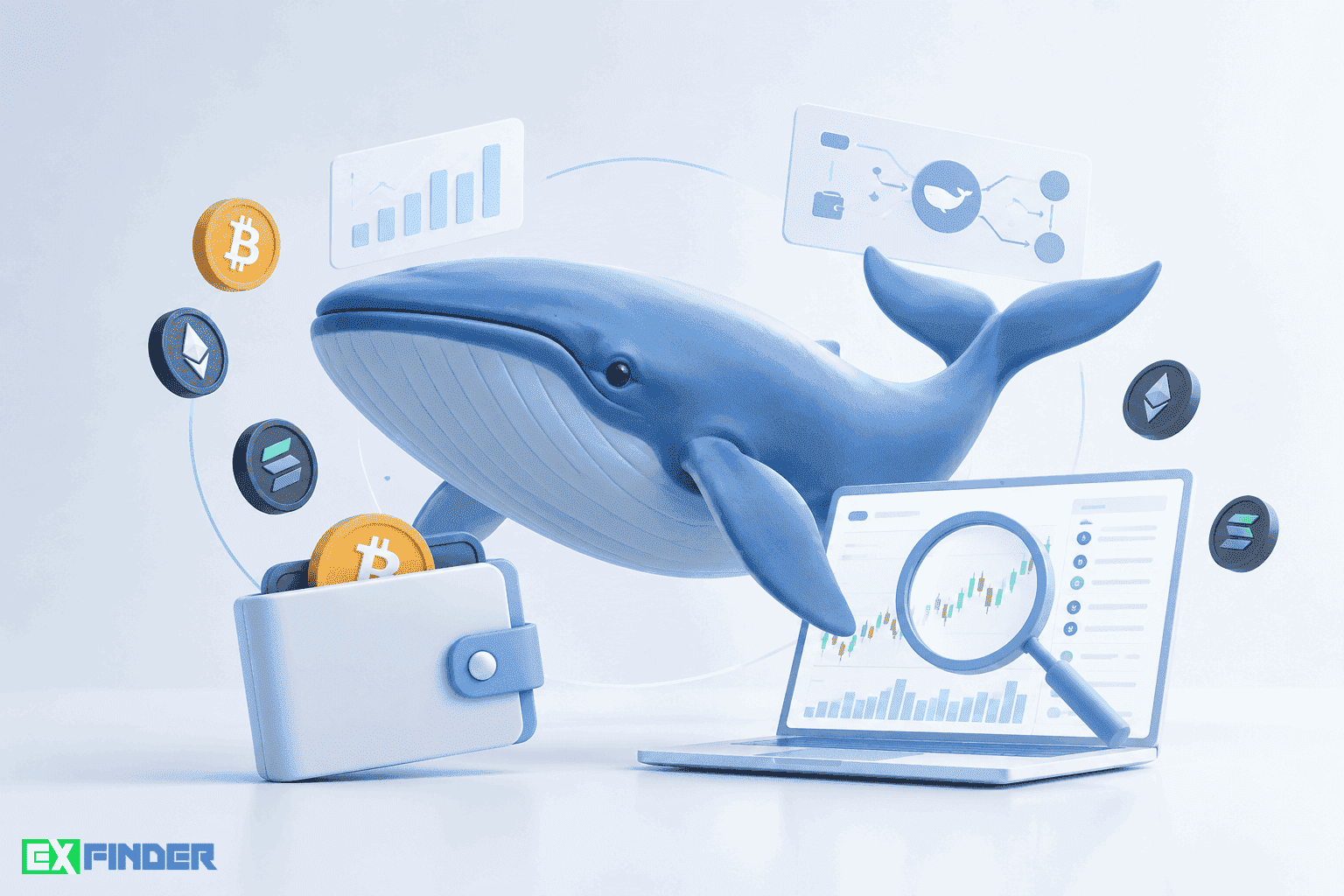
Whale activity refers to high-volume cryptocurrency transfers (typically exceeding $1 million or 1,000+ BTC / 10,000+ ETH) executed by high-net-worth individuals, hedge funds, or institutional entities. Because whales control a substantial percentage of total market supply, their actions—buying, selling, or moving capital between wallets—can trigger immediate and severe price fluctuations. Monitoring On-Chain data allows market participants to anticipate trend reversals and select optimal times for exchanging digital assets into fiat currency.
1. Who Are Crypto Whales: The Anatomy of Large Capital
In the cryptocurrency ecosystem, the term "whales" refers to entities holding sufficiently vast amounts of a specific digital asset that their single orders or transfers can dramatically shift prevailing market spot prices. For Bitcoin, the traditional threshold to enter the whale category is maintaining a balance of 1,000 BTC or more. For Ethereum networks, this baseline generally starts at 10,000 ETH. However, for lower-market-cap altcoins or newly launched tokens, any wallet holding more than 1% to 2% of the circulating token supply is considered a whale.
It is crucial to recognize that whales do not operate as a unified, monolithic group with identical motives. Institutional capital breaks down into distinct archetypes, each exhibiting unique trading cadences and investment horizons:
- Institutional Funds & Spot ETFs: Major asset management entities like BlackRock, Grayscale, or Fidelity, whose wallet balances are publicly monitored and whose treasury movements trigger massive market momentum. They manage billions of dollars and operate predominantly on multi-year time horizons.
- Centralized Exchange Infrastructure (Exchange Hot/Cold Wallets): Operational wallets maintained by platforms like Binance, Coinbase, or OKX. While holding hundreds of thousands of coins, most of their internal transactions are routine infrastructure maintenance (e.g., rebalancing reserves between hot and cold storage).
- Early Adopters & Early Miners (OG Whales): Participants who mined or acquired native tokens between 2010 and 2015. Their holdings often remain dormant for years; thus, any unexpected movement from these addresses induces significant panic throughout the market.
- Market Makers & Algorithmic Trading Firms: Quantitative entities such as Wintermute or Jump Crypto, which supply market orderbook liquidity and perform cross-exchange arbitrage. They generate massive daily transaction volumes.
- Sovereign Nations & Law Enforcement Custodies: Governments (such as the US, Germany, or China) that seized digital assets during criminal investigations. Moves from state-controlled addresses are almost universally interpreted as immediate sell pressure via public auctions or exchange dumps.
Because blockchain architecture is natively transparent, every large-scale capital transfer is permanently registered on an immutable ledger. Analyzing this raw data grants retail traders an edge—allowing them to detect institutional footprints long before official press releases or breaking news stories reach public media.
2. Why Whale Activity Is Decisive for Market Movements
Unlike traditional equity markets, where major players operate through off-exchange Dark Pools or submit delayed quarterly reports (such as SEC Form 13F filings), the cryptocurrency market operates 24/7/365 in real time. Whale activity forms the core foundation of On-Chain analysis, which directly evaluates network metrics and participant behavior straight from the underlying ledger.
The impact of whale movements is evaluated across three primary market mechanics:
- Establishing Prevailing Trends: While retail traders generate minor day-to-day noise, overall price trajectory is set by the net directional flow of whale capital. Systematic whale accumulation indicates an impending bull run, while persistent distribution marks the onset of a macro bear market.
- Orderbook Depth & Liquidity Cascades: A massive market sell order placed by a whale can instantly clear out multiple buy levels within orderbooks, triggering automated liquidation cascades across leveraged margin positions. This phenomenon frequently results in sudden "Flash Crashes," where asset prices plummet 10% to 20% in minutes.
- Information Asymmetry Metrics: Whales regularly maintain superior analytical resources, proprietary research, or advance knowledge regarding regulatory and technical developments. Their On-Chain actions reveal their unvarnished market outlook, bypassing public narrative noise.
For everyday users planning substantial transaction execution—such as converting crypto holdings into cash fiat via online exchange aggregators—understanding whale movements prevents unnecessary financial slippage. Executing a swap right as whales initiate a major exchange selloff can result in losing significant capital due to sudden rate drops during transaction confirmation windows.
3. Primary Types of Whale Transactions & Deep Interpretation
When tracking high-volume wallets, analyzing the gross transfer amount is insufficient. The most critical variables are the directional flow and the entity types involved on both sides of the transaction:
3.1. Wallet-to-Exchange Transfers (Exchange Inflow)
This represents the most straightforward bearish signal. When a whale transfers 5,000 BTC from self-custody cold storage onto a centralized exchange deposit address (such as Binance or Coinbase), it typically indicates intent to liquidate, open leveraged short positions, or convert assets into stablecoins. Sustained spikes in Exchange Inflows reliably increase immediate Sell Pressure.
3.2. Exchange-to-Wallet Transfers (Exchange Outflow)
A classic bullish signal. Moving digital assets off centralized trading desks and into cold storage signals that the whale intends to hold long term (HODL). This reduces the exchange's available liquid supply. When Outflows become widespread, a supply squeeze occurs, applying upward pressure on market prices.
3.3. Private Wallet-to-Wallet Transfers (Internal / OTC)
A neutral or complex signal requiring contextual analysis. Transfers between unlabelled addresses usually represent one of the following scenarios:
- Over-The-Counter (OTC) Deals: Direct block trades between two major entities off public orderbooks to avoid inducing market slippage.
- Custodial Restructuring: Upgrading cold storage security configurations, such as migrating funds to modern multi-signature (Multisig) architecture.
- Internal Exchange Rebalancing: Routine transfers between an exchange's hot transaction wallet and cold custody vaults.
3.4. DeFi Protocol Interactions & Cross-Chain Bridges
Large-scale transfers of stablecoins (USDT, USDC) from central exchanges into decentralized protocols (such as Aave, Uniswap, or MakerDAO) signal readiness to purchase altcoins or provide liquidity for yield generation. Conversely, pulling liquidity out of DeFi protocols to convert back into fiat or native L1 tokens points toward a capital preservation strategy (Risk-Off mode).
4. Key On-Chain Metrics for Evaluating Whale Activity
Beyond individual transaction alerts, professional analysts rely on aggregated On-Chain metrics to gauge overall institutional positioning:
- Exchange Whale Ratio: The relative proportion of the top 10 exchange inflow transactions compared to overall exchange deposits. A Whale Ratio exceeding 85% signals that exchanges are flooded with large-holder tokens, elevating short-term dump risks.
- Exchange Netflow: The net difference between incoming (Inflow) and outgoing (Outflow) token volume across exchanges. Negative Netflow confirms that withdrawals outweigh deposits, denoting ongoing accumulation.
- Supply Outside of Exchanges: The percentage of an asset's total circulating supply held in private wallets. A rising metric establishes a long-term bullish structural base.
- Accumulation Trend Score: A proprietary metric (popularized by Glassnode) reflecting whether large entities are actively adding to their positions (values approaching 1.0) or distributing assets (values approaching 0.0).
5. Step-by-Step Guide: How to Read On-Chain Signals
To avoid falling victim to false alarms and systematically integrate whale tracking into your strategy, follow this structured analytical checklist:
Step 1: Signal Detection. You receive a notification recording a single transaction exceeding $10,000,000 via a dedicated tracking bot or platform.
Step 2: Entity Identification. Verify origin and destination wallet tags using entity-attribution tools. If both addresses belong to the same entity (e.g., Binance 14 ➡️ Binance 8), mark it as an internal technical move and disregard it.
Step 3: Historical Wallet Profiling. Review the historical behavior of the sending wallet. Does this address historically deposit funds immediately prior to sharp market pullbacks? Is it an institutional market maker's operational pool?
Step 4: Cross-Referencing Derivatives & DeFi Data. Check if the transfer coincides with spikes in Open Interest (OI) or collateral deposits in protocols like Aave or Hyperliquid. Assets are sometimes moved to exchanges to collateralize complex hedge strategies rather than spot sales.
Step 5: Execution Strategy. If you intend to convert crypto to fiat via an exchange monitoring platform, lock in your exchange rate immediately if heavy Exchange Inflows are confirmed. If persistent Outflows dominate, waiting may net a higher conversion rate.
6. Detailed Overview of Whale Tracking Tools
Modern On-Chain analysis relies on a tech stack combining real-time alert systems, deep entity resolution, and macro charts:
Whale Alert
The premier real-time tracking service broadcasting high-value transactions directly across social media channels (X/Twitter) and Telegram feeds. Covering multiple blockchain ecosystems, it serves as an excellent early-warning system for sudden volume spikes.
Arkham Intelligence
An advanced analytical engine focused on entity deanonymization. Arkham links raw wallet addresses to real-world entities (hedge funds, exchanges, high-profile individuals) and visualizes transaction flows via interactive visual graphs.
Nansen
A flagship analytics platform focused on tracking "Smart Money." Nansen tags millions of wallet addresses into behavioral groups—such as VC Funds, Flashbots Miners, High-Win-Rate Traders, and NFT Whales. Its "Token God Mode" module exposes holder concentration in real time.
CoinLobster
A real-time terminal consolidating On-Chain alerts with orderbook dynamics, capturing live executed spot trades over $1 million, liquidation events, and sudden open interest shifts across major derivatives exchanges.
Glassnode & CryptoQuant
Industry-standard macro-analytics platforms. They specialize in aggregated metrics, offering indicators like exchange reserve trends, MVRV Z-Scores, SOPR, and realized profit/loss metrics to identify macro market cycle tops and bottoms.
Dune Analytics
A community-driven data platform enabling analysts to construct custom dashboards querying raw blockchain data using SQL. Dune is ideal for tracking niche altcoin whales, protocol-specific staking flows, and emerging Layer-2 activity.
7. Comparison Matrix: Free vs. Paid Analytics Platforms
The comparative matrix below outlines the primary features, access models, and target use cases for leading whale analysis tools:
| Platform | Core Focus Area | Access Tier | Complexity Level | Optimal Use Case |
|---|---|---|---|---|
| Whale Alert | Real-time On-Chain transaction alert feed | Free (Paid API available) | Beginner 🟢 | Immediate notifications of raw volume transfers |
| Arkham Intelligence | Entity deanonymization & wallet network visualizer | Freemium | Intermediate 🟡 | Investigating specific wallet owners & counter-parties |
| Nansen | Smart Money analytics & behavioral portfolio tracking | Paid (Limited trial) | Professional 🔴 | Following high-win-rate wallets and capital trends |
| CoinLobster | Live $1M+ trade stream & combined spot/derivatives data | Freemium | Intermediate 🟡 | Tracking immediate market order execution & liquidations |
| Glassnode | Macro On-Chain economic indicators & cycle metrics | Freemium | Professional 🔴 | Long-term cycle forecasting & macro market health |
| DeBank | Web3 DeFi portfolio tracking & yield monitoring | Free | Beginner 🟢 | Assessing whale holdings across decentralized protocols |
| Dune Analytics | Custom SQL-driven dashboards & community metrics | Free | Professional 🔴 | Deep-dive research on niche tokens and L2 chains |
8. Psychology of Manipulation & Fake Inflows: How Whales Mislead Retail
Seasoned market participants understand a vital reality: whales are fully aware that thousands of retail traders monitor public tools like Whale Alert. Consequently, large actors frequently weaponize blockchain transparency to engineer artificial market panic or FOMO.
Common manipulative tactics deployed by large entities include:
- Spoofing & Fake Inflows: A whale deposits a massive token volume onto an exchange with zero intention of selling. Bot aggregators trigger instant alerts, instigating retail Panic Selling and short positioning. The whale then uses hidden limit orders to buy up panicked retail liquidity at a discount before withdrawing the original deposit.
- Wash Trading: Shuffling tokens rapidly between self-controlled wallets to manufacture fake volume metrics, misleading technical screeners into flagging fake momentum.
- Spoofed Orderbook Walls: Placing gigantic buy or sell limit orders on central orderbooks to push algorithmic trading bots in a target direction, only to cancel the order seconds before price execution occurs.
- Split Transactions (Fragmented Transfers): Breaking down a multi-million-dollar transaction into hundreds of smaller transfers (e.g., 10 BTC batches) to bypass Whale Alert thresholds and execute stealth accumulation or distribution.
💡 Case Study in Market Manipulation:
In June 2023, a dormant whale address transferred 15,000 ETH to a Binance deposit address. Within minutes of the notification being broadcast, spot Ethereum prices dropped 3.5%. However, subsequent On-Chain analysis revealed that the ETH was never sold—it was pledged as collateral to open a leveraged long position. The market rebounded sharply, liquidating retail traders who had panic-shorted the alert.
9. Safety Regulations, AML Checks, and Protecting Against Tainted Funds
Beyond price forecasting, analyzing whale interactions plays a mandatory role in asset protection and Anti-Money Laundering (AML) compliance during real-world exchanges.
⚠️ Warning Regarding AML Risk & Tainted Assets:
When tracking high-volume transactions, remember to maintain strict wallet hygiene. High-volume transfers occasionally originate from illicit mixing protocols (e.g., Tornado Cash, Sinbad), darknet markets, or exploit exploits. Forensic analytical systems mark these funds as High Risk. Receiving funds from a wallet directly linked to a blacklisted whale can result in immediate freeze actions by centralized exchanges or fiat exchange services, requiring extensive proof-of-funds documentation to resolve.
Proactive risk mitigation measures for high-volume traders:
- Screen incoming target addresses using automated AML diagnostic tools (such as AMLBot or Crystal Intelligence) prior to initiating transactions.
- Avoid accepting direct P2P transfers from unknown high-volume addresses into your primary exchange deposit accounts.
- Utilize reputable exchange monitoring services that verify provider liquidity and compliance standards.
10. Utilizing Whale Activity to Optimize Rates on Exchange Aggregators
When planning to convert digital assets into fiat currency (USD, EUR, etc.) or rebalance portfolios via online crypto exchange aggregators, tracking whale flows yields significant operational advantages:
- Execution Timing Optimization: Consistent whale exchange Outflows signal a healthy, accumulation-driven spot market—meaning holding off on your conversion for a few hours may yield a better rate. Conversely, heavy Exchange Inflows signal impending slippage; lock in your conversion rate immediately.
- Securing Fixed-Rate Conversions (Fix Rate): During high-volatility events induced by whale moves, select exchange services via monitoring aggregators that offer rate-lock guarantees. This protects your transaction from unexpected downward price swings while waiting for block confirmations.
- Verifying Exchange Liquidity: When executing major exchanges, cross-reference the exchange provider's stated reserves on aggregator platforms. The exchanger must maintain sufficient reserves so your order can be executed without forcing them to hedge directly on open spot books during market stress.
11. FAQ
What minimum balance qualifies a wallet holder as a "whale"?
For Bitcoin, the standard baseline is 1,000 BTC; for Ethereum, it is typically 10,000 ETH. In fiat terms, transfers or holdings exceeding $10,000,000 qualify. For lower-cap altcoins, holding over 1% of the circulating supply constitutes whale status.
Is monitoring whale wallets completely legal?
Yes, whale tracking is 100% legal. Public blockchains (such as Bitcoin, Ethereum, and Solana) operate as open ledgers. Anyone has the right to inspect, monitor, and analyze transaction data and account balances in real time.
Does an exchange deposit always mean an immediate sale is coming?
No. Funds are also transferred to exchanges to provide liquidity for derivatives contracts, execute off-book Over-The-Counter (OTC) settlements, participate in staking programs, or serve as loan collateral. However, statistically, large deposits significantly increase the probability of spot sell pressure.
What is the difference between "Smart Money" and a standard whale?
Smart Money refers specifically to wallets with a proven historical track record of high profitability (e.g., top-performing quantitative funds or early-stage VCs). A standard whale may simply be an early miner holding assets without active trading expertise.
How does whale tracking assist when converting crypto to cash?
It provides critical execution timing. If whale inflows hint at a market-wide selloff, converting your crypto via an exchange aggregator before the dump secures your purchasing power. Securing locked rates prevents slippage losses caused by market panic.
12. Conclusion and Practical Key Takeaways
Tracking Whale Activity is not a crystal ball for predicting short-term price movements with absolute certainty; rather, it is a sophisticated analytical framework that eliminates blind spots for retail investors. Understanding how institutional capital moves through the blockchain enables market participants to make informed, data-driven financial decisions.
The primary rule when interpreting On-Chain data is to avoid reacting emotionally to isolated transaction alerts. Combine real-time notifications from Whale Alert with deep contextual analysis via Arkham and Nansen, maintain strict AML compliance verification, and plan your exchange transactions with clear risk management parameters.
Ready to exchange your crypto holdings at the most competitive rates? Use our exchange monitoring platform to compare real-time exchange rates, verified liquidity reserves, and security ratings to execute your trades safely today!