Artificial intelligence is gradually changing the way users choose services for buying, selling and exchanging digital assets. In the past, a person had to open dozens of websites manually, compare rates, check fees and read reviews one by one. Today, a large part of that work can be handled by algorithms. For a crypto exchange monitoring website, this is especially important: users do not come only to see a list of services, but to find a profitable, fast and secure option for a specific transaction.
The cryptocurrency market is extremely dynamic. The price of Bitcoin, Ethereum, USDT and many other assets may change within minutes, and sometimes within seconds. On top of that, users must consider payment system fees, blockchain network costs, exchange limits, available reserves, request processing speed and the reputation of the exchanger itself. That is why finding the best offer is no longer just a matter of choosing the largest number in a comparison table.
Modern algorithms analyze more parameters than a person can quickly check manually. They help identify top crypto exchangers, find the best crypto exchanger for a specific direction, understand where to buy Bitcoin online at a better rate, and perform fiat-to-crypto exchange more safely. As a result, the user receives not a random list of providers, but a structured view of the market.
What AI Means in Crypto Exchangers
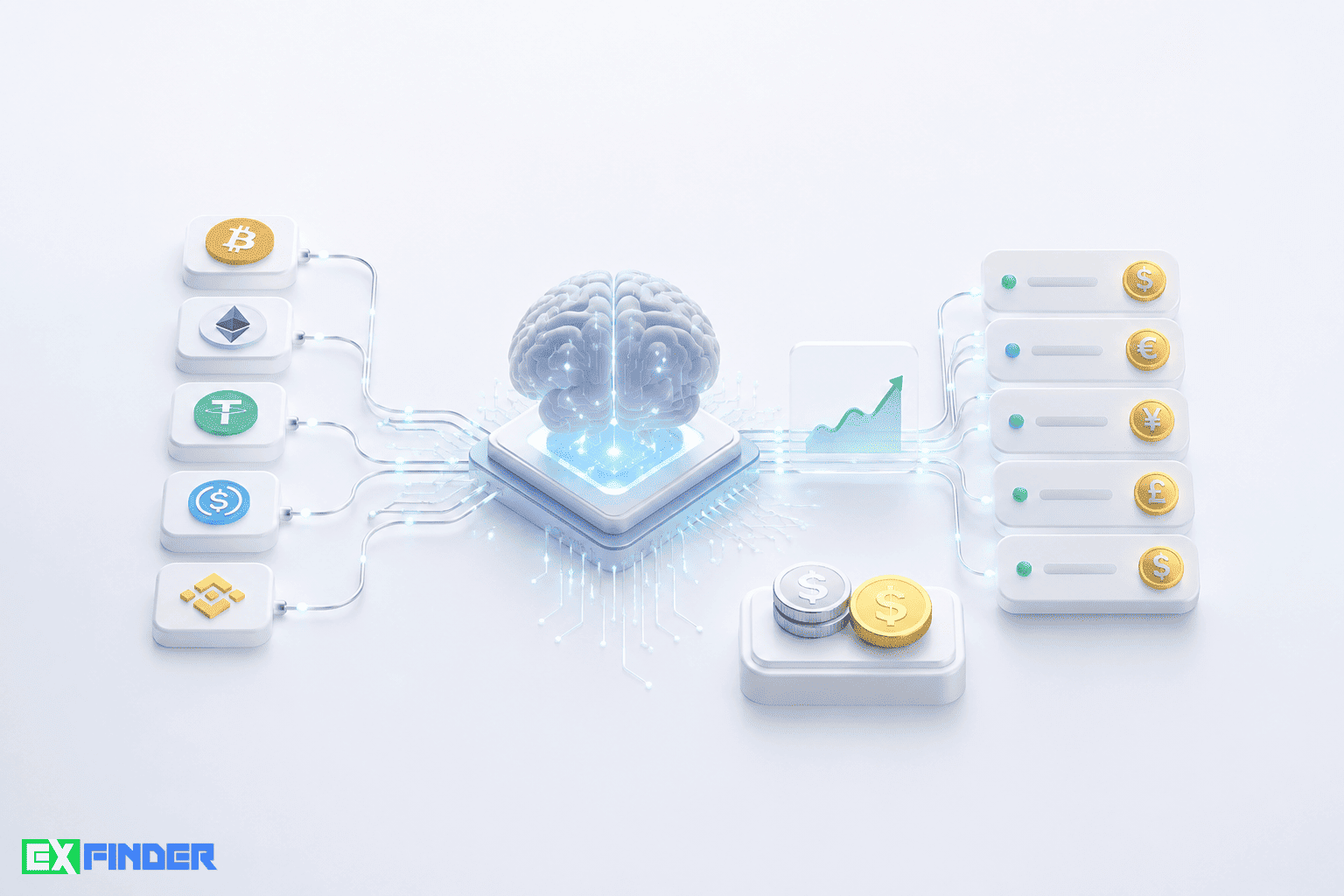
AI in crypto exchangers is not a single separate tool, but a set of technologies that help collect, clean, compare and analyze data. It may include machine learning, automatic classification of exchangers, predictive models, anomaly detection algorithms, risk scoring systems and tools for ranking search results.
In the context of crypto exchange monitoring, AI does not necessarily execute the transaction itself. Its main role is to help the user see better data. For example, an algorithm may determine that one provider shows an attractive exchange rate but often delays orders, while another offers a slightly less profitable rate but works consistently, has sufficient reserves and maintains a strong user rating.
For the user, the process looks simple: they choose a direction, such as USD to Bitcoin or USDT to a bank card, and the system displays available options. Behind the scenes, however, a complex analysis is taking place: the system checks rate freshness, reserve availability, fee structure, supported networks, service history and other important factors.
Important: AI does not remove the need for personal attention. Before confirming an order, users should always check the final rate, the amount to be received, the transfer network and the payment details. Algorithms help make a better choice, but the final decision always remains with the user.
Why Comparing Rates Alone Is No Longer Enough
Many beginners choose an exchanger by one criterion only — the best visible rate. At first glance, this seems logical: if a user wants to buy Bitcoin cheaper or sell USDT at a higher price, they naturally look at the top offer in the table. In practice, however, the most attractive rate does not always produce the best final result.
For example, an exchanger may show a strong rate but add an extra fee at the final step. Another service may set a high minimum amount or require additional verification. A third provider may not have enough reserve, which means the order cannot be completed immediately. As a result, the user may spend more time, receive less money or face unexpected conditions.
That is why high-quality monitoring must evaluate the full picture. The best crypto exchanger is not always the one with the highest displayed rate. It is the service that combines competitive pricing, clear rules, sufficient reserves, fast order processing and a trustworthy reputation.
What Data Algorithms Analyze
To help a user find the optimal option, algorithms analyze dozens of parameters. Some of them are obvious, such as the exchange rate and reserve. Others are less visible but equally important: update frequency, service uptime, rating changes, complaint history and the difference between declared and actual processing time.
One of the key parameters is the effective exchange rate. This is the real value after all fees and possible costs are considered. If a user wants to know where to buy Bitcoin online at a better price, it is important to compare not only the displayed rate, but also the final amount they will receive after the exchange is completed.
The second important factor is low crypto exchange fees. A fee may be built into the rate, shown separately or depend on the payment method. Bank cards, e-wallets, blockchain transfers and international payment systems may all have different cost structures. AI helps compare these conditions quickly and shows a more realistic picture.
The third factor is reserve. If a service does not have enough funds in the required currency, the user will not be able to complete an exchange for the desired amount. This is especially important for large orders and popular directions, where USDT exchangers or Bitcoin exchangers may change their available balances quickly.
Manual Choice vs AI Monitoring
| Criterion | Manual Search | AI Monitoring |
|---|---|---|
| Analysis speed | Many websites must be checked manually | Data is compared automatically within seconds |
| Exchange rate | The user usually sees only the displayed rate | The effective rate can be assessed with costs included |
| Fees | Often hidden in service terms or checkout steps | The algorithm accounts for visible and typical extra costs |
| Reserves | Checked separately on each exchanger website | Shown immediately for the selected exchange direction |
| Reputation | Requires manual review reading | Rating, history and complaint dynamics are considered |
| Risks | Beginners may miss warning signs | The system can detect anomalies and suspicious changes |
How AI Helps Find the Best Exchange Rate
Algorithms do not simply sort exchangers by rate. They evaluate whether an offer is realistic, stable and actually available at the current moment. If a service displays a good rate but its reserve is shrinking quickly or its orders are often delayed, the system may take that into account when ranking results.
This approach is especially useful for popular exchange directions, such as buying Bitcoin with a card, exchanging USDT to a bank account or selling crypto for fiat. In these cases, the difference between exchangers may look small at first, but become significant after fees, network costs and execution speed are included.
When a user enters an exchange direction, the system can consider the amount, currency, payment method, available network, exchanger restrictions and overall rating. As a result, the list becomes more useful: it shows not just top crypto exchangers, but the options that are most suitable for a specific transaction.
Fee Analysis and Hidden Costs
Fees are one of the main reasons why a user may receive less than expected. In the crypto market, total costs may include the exchanger’s fee, bank fees, payment provider charges, blockchain network fees and the difference between the market price and the internal rate of the service.
For example, a user may see a good rate for buying Bitcoin, but after creating an order discover that the bank charges an additional percentage, while the network fee makes a small transaction less profitable. AI monitoring helps find services where low crypto exchange fees are combined with transparent conditions.
For a monitoring website, this is an important trust factor. Users return to platforms that do not simply display attractive numbers, but help avoid unpleasant surprises. The better an algorithm explains the difference between the displayed rate and the actual amount to be received, the more useful the monitoring service becomes.
The Role of Reserves and Liquidity
Reserve shows how much money an exchanger can provide in a specific currency. If a user wants to sell a large amount of USDT or buy a significant amount of Bitcoin, reserve becomes critical. Even the best rate has no practical value if the provider cannot complete the order.
Liquidity is connected not only to the current reserve, but also to the exchanger’s ability to process a steady flow of requests. If a service consistently maintains reserves, updates rates quickly and avoids delays during high traffic, this becomes a positive signal for the algorithm.
AI can analyze historical data and notice patterns. For example, a certain exchanger may have enough reserve during business days but regularly limit operations on weekends. Another provider may process small orders quickly but take much longer for larger transactions. These details matter for users who want not only to find a rate, but to complete the exchange without unnecessary delays.
How Algorithms Evaluate Exchanger Reliability
Reliability is one of the main criteria in crypto exchange. A user sends money or cryptocurrency to a service, so they must be confident that the operation will be completed correctly. That is why reliable crypto exchangers should be evaluated not only by price, but also by operating history, transparent rules and support quality.
Algorithms can analyze user reviews, response speed to complaints, the number of unresolved issues, domain change frequency, website stability, public information and other indirect signals. If a service suddenly receives many identical positive reviews or changes its terms without explanation, the system may mark this as a risk factor.
Support quality is also important. If an exchanger responds quickly, explains delays and solves problems, trust increases. If orders get stuck and support ignores users, even a good rate does not compensate for the risk.
AI and Security: Detecting Suspicious Signals
Artificial intelligence can be useful not only for finding rates, but also for detecting potentially dangerous situations. For example, an algorithm may notice a sharp deviation from the market rate, unusual reserve changes, a sudden wave of negative reviews or abnormal service behavior.
A suspiciously profitable rate does not always mean fraud, but it does require additional checking. Sometimes it may be a promotion or a temporary advantage in a specific direction. But if the offer comes together with poor reviews, missing reserves or unclear terms, the user should be careful.
This is especially important for beginners. A person making their first fiat-to-crypto exchange may not know which signs are normal and which should raise concern. Monitoring with intelligent algorithms helps reduce the risk of mistakes and makes it easier to navigate a large number of providers.
Comparison Table of Exchanger Characteristics
| Characteristic | Why It Matters | How AI Helps |
|---|---|---|
| Fee | Affects the final amount the user receives | Compares service conditions and identifies more expensive options |
| Processing time | Important during market volatility | Estimates the average speed of order completion |
| Available currencies | Shows whether the service supports the required direction | Filters exchangers by crypto assets, fiat currencies and networks |
| Reserve | Shows whether the service can complete the order | Removes options with insufficient available balance |
| User rating | Helps evaluate the experience of other customers | Analyzes review dynamics and possible anomalies |
How to Choose an Exchanger Using Monitoring
The question of how to choose a crypto exchanger is relevant for both beginners and experienced users. There is no universal answer because everything depends on the specific transaction: amount, currency, urgency, payment method and acceptable risk level. However, there are basic rules that help users make a better decision.
- Compare not only the rate, but also the final amount to be received.
- Check the reserve of the required currency before creating an order.
- Pay attention to the rating and the number of real reviews.
- Evaluate processing speed, especially during sharp market movements.
- Check whether the service supports the required network for USDT, BTC or another asset.
- Do not choose a service only because of a suspiciously profitable rate.
- Before payment, carefully verify the details and conditions of the order.
If a user is looking for the best crypto exchanger, they should consider the balance between value and security. Sometimes it is better to choose a provider with a slightly less attractive rate but a stronger reputation, faster support and clearer conditions.
Where to Buy Bitcoin: The Role of Algorithms in Timing
The question of where to buy Bitcoin depends not only on the exchanger, but also on the timing of the purchase. Bitcoin is a volatile asset, so its price may change quickly due to news, large market participants, macroeconomic events or general market sentiment.
AI cannot guarantee a perfect entry point, but it can help users better understand current conditions. Algorithms may analyze price dynamics, compare rate deviations between exchangers, detect temporary gaps and show when an offer is better than the market average.
For users, this means that monitoring becomes more than a simple directory of services. It becomes a decision-making tool. It helps show which USDT exchangers, Bitcoin exchangers or other crypto services currently offer competitive conditions, and which should be skipped because of weak reserves, high fees or questionable reputation.
Benefits of Using AI in Crypto Exchangers
The main benefit of AI is speed. A person cannot manually process hundreds of rates, reserves and reviews in real time. Algorithms do this automatically, so the user receives more up-to-date information and spends less time searching.
The second benefit is comprehensive analysis. The system evaluates not one parameter, but a full set of factors. This makes it easier to understand which top crypto exchangers are truly suitable for a specific direction and which look attractive only at first glance.
The third benefit is risk reduction. Algorithms can detect unusual changes, suspicious reviews, unstable reserves and other signals that a user might miss. In an industry where a mistake may cost real money, this is highly important.
Limitations of Algorithms
Despite all the advantages, AI is not a magic tool. An algorithm works with the data available to it. If an exchanger provides delayed information or changes conditions without warning, the system may not reflect it immediately. That is why users should always verify the final details before making a payment.
Another limitation is market unpredictability. Even the best model cannot know exactly how the price will change in a few minutes. It can show trends, find deviations and suggest better options, but it cannot guarantee absolute profit.
It is also important to understand that a rating is a helpful tool, not a replacement for common sense. If an offer looks too good to be true, it should be checked more carefully: reviews, terms, reserve, minimum amount and verification requirements all matter.
How to Avoid Fraud During Exchange
Even in a developed market, questionable services, phishing copies and exchangers with unclear conditions may appear. To reduce risks, users should follow basic security rules.
- Go to an exchanger only through a verified monitoring platform or a saved bookmark.
- Check the website domain before entering any information.
- Do not trust rates that differ sharply from the market without a clear explanation.
- Do not send funds if the order conditions suddenly change.
- Keep the order number and payment confirmation until the transaction is completed.
- For large amounts, choose reliable crypto exchangers with operating history and support.
A monitoring service helps shorten the path to a safer choice, but user attention remains an important part of the process. The best strategy is to combine automatic analysis with personal verification of the key details.
FAQ
Can AI guarantee the best exchange rate?
AI helps find the most attractive available offers based on current data, but it cannot guarantee that a rate will remain unchanged. The crypto market moves quickly, so final conditions should be checked before creating and paying for an order.
What matters more: rate or exchanger reputation?
Both factors matter. A profitable rate only makes sense when the service completes orders reliably, has enough reserve and maintains a positive operating history. For larger amounts, it is better to choose a balance between value and trust.
Where can I buy Bitcoin at a better price?
The most convenient way is to compare offers through an exchanger monitoring platform. It allows users to quickly evaluate rate, fee, reserve, processing speed and user reviews for the selected direction.
What are USDT exchangers?
USDT exchangers are services that support buying, selling or exchanging the USDT stablecoin. It is important to pay attention to the transfer network, such as TRC20, ERC20 or BEP20, because fees and speed may differ.
How do I choose an exchanger for fiat?
You should check the supported payment method, rate, fee, limits, order processing time and service reputation. For fiat-to-crypto exchange, it is also important to consider possible bank restrictions.
Does a low exchange fee always mean a better deal?
Not always. A low crypto exchange fee may be offset by a weaker rate or additional conditions. Users should compare the final amount they will receive after the transaction is completed.
Can I fully trust exchanger ratings?
A rating is a useful guideline, but it should be considered together with other parameters: reserve, rate, speed, reviews and transparency of terms. The best decision is based on a comprehensive assessment.
Conclusion
Artificial intelligence makes choosing a crypto exchanger faster, more accurate and safer. Algorithms analyze rates, fees, reserves, liquidity, order processing speed, provider reputation and possible risks. Thanks to this, users can find top crypto exchangers faster, choose the best crypto exchanger for a specific direction and better understand where to buy Bitcoin online or how to complete a fiat-to-crypto exchange.
At the same time, AI does not replace attention. Before paying for an order, users should check the final rate, network, amount to be received, fee and payment details. The best result comes from combining high-quality monitoring, automated analysis and basic security rules.