Top cryptocurrency exchanges, trading platforms, and analytics services display dozens of different crypto metrics, but most beginners focus only on the price of a coin. Because of this, investors often misjudge the true value of a cryptocurrency and buy tokens without understanding their actual economics.
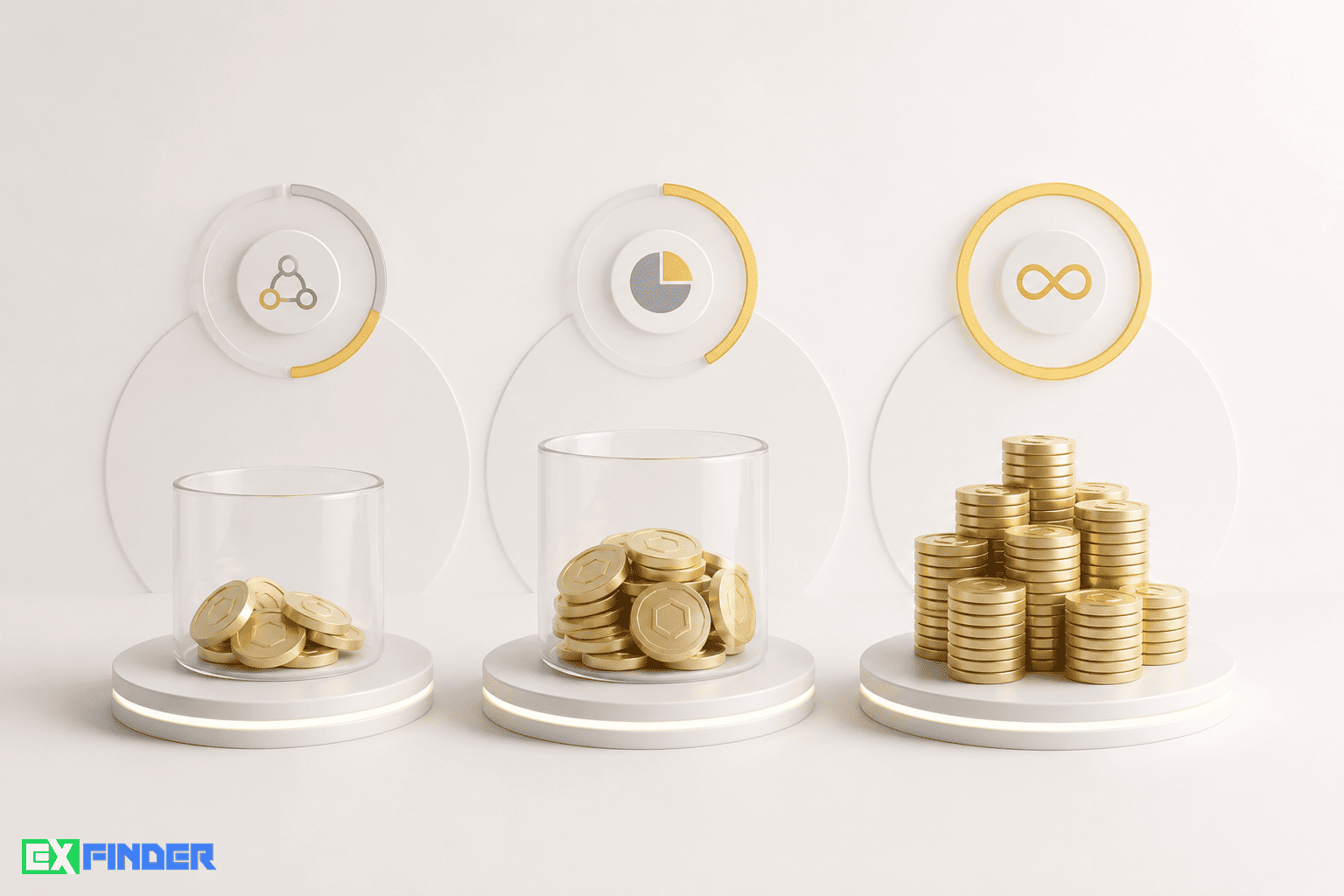
One of the most important concepts in crypto is supply — the number of coins or tokens that exist within a blockchain ecosystem. Circulating supply, total supply, and max supply directly affect market capitalization, inflation, scarcity, and long-term value. In this article, we will explain what these metrics mean, how they work, and why professional investors always analyze supply before buying a cryptocurrency.
What Is Supply in Cryptocurrency
Supply in cryptocurrency refers to the number of coins or tokens that exist within a blockchain network. Supply determines how scarce an asset is and strongly influences its future price potential.
Many beginners only look at the price of a single coin, but this is a major mistake. For example, a token worth $0.01 can actually be more overvalued than Bitcoin if its supply is extremely large.
There are three main types of supply in crypto:
- circulating supply;
- total supply;
- max supply.
These metrics are used to calculate market capitalization and evaluate a cryptocurrency’s long-term potential.
Without understanding supply, it is almost impossible to properly analyze a crypto asset.
How Circulating Supply, Total Supply, and Max Supply Work
| Metric | Meaning | Why It Matters |
|---|---|---|
| Circulating Supply | Coins currently available on the market | Affects market capitalization |
| Total Supply | Total amount of created coins | Shows real token issuance |
| Max Supply | Maximum possible number of coins | Determines scarcity |
What Is Circulating Supply
Circulating supply is the number of coins currently available for trading on the market.
This metric is used to calculate market capitalization:
Market Cap = Price × Circulating Supply
For example, if a coin costs $5 and has a circulating supply of 20 million tokens, its market capitalization is $100 million.
Circulating supply constantly changes because new tokens can enter the market through mining, staking rewards, or token unlocks.
What Is Total Supply
Total supply represents the total number of coins that currently exist.
Total supply includes:
- coins in circulation;
- locked tokens;
- team reserves;
- foundation allocations;
- staked assets.
However, not all total supply is available for trading.
What Is Max Supply
Max supply refers to the maximum number of coins that can ever exist.
Examples:
- Bitcoin has a max supply of 21 million;
- Dogecoin has no fixed max supply;
- Ethereum uses a more flexible issuance model.
Max supply plays a major role in determining scarcity and long-term inflation.
Main Types of Supply Models
| Supply Model | Advantages | Disadvantages | Example |
|---|---|---|---|
| Fixed Supply | High scarcity | Less flexibility | Bitcoin |
| Inflationary Model | Supports network security | Price pressure | Ethereum |
| Burn Model | Reduces supply | Depends on network activity | BNB |
| Unlimited Supply | Flexible issuance | Higher inflation | Dogecoin |
Fixed Max Supply
Coins with a limited max supply are often viewed as scarce assets.
This is why many investors compare Bitcoin to digital gold.
Inflationary Models
Some blockchains continuously issue new tokens to reward validators and secure the network.
Burn Mechanisms
Some projects regularly burn tokens to reduce supply over time.
This helps maintain scarcity and potentially supports long-term value growth.
How Supply Affects Cryptocurrency Prices
Supply directly affects the market valuation of a cryptocurrency. This is why professional investors never focus only on price.
For example, if two projects have the same market capitalization but very different supplies, their coin prices can vary dramatically.
Example:
- Coin A has a supply of 1 million tokens;
- Coin B has a supply of 1 billion tokens.
Even with the same market cap, Coin A would have a much higher price because its supply is smaller.
This is why a low token price does not automatically mean a cryptocurrency is “cheap.”
Why Inflation Matters
If a cryptocurrency continuously issues new tokens, it can create selling pressure on the market.
Investors should analyze:
- annual inflation rate;
- unlock schedules;
- supply growth speed;
- token distribution.
Even strong projects can struggle to grow if token issuance is too aggressive.
Why Burn Mechanisms Became Popular
Burning is a mechanism that permanently removes tokens from circulation.
Many blockchains use burns to:
- reduce inflation;
- increase scarcity;
- support long-term value.
This is why investors often react positively to burn announcements and deflationary systems.
Advantages and Disadvantages of Different Supply Models
Advantages of Limited Max Supply
- higher scarcity;
- better inflation protection;
- strong appeal for long-term investors;
- easier market analysis.
Disadvantages
- higher volatility;
- less network flexibility;
- risk of token concentration among whales.
Advantages of Inflationary Models
- supports network stability;
- rewards validators;
- helps ecosystem growth.
Disadvantages of Inflationary Models
- token dilution;
- selling pressure;
- lower scarcity.
How to Analyze Coin Supply
When analyzing a cryptocurrency, investors should look beyond price and compare circulating supply, total supply, and max supply.
What Investors Should Check
- percentage of tokens already in circulation;
- future token unlocks;
- burn mechanisms;
- who controls the supply;
- token inflation speed.
If only a small percentage of tokens are currently circulating, future unlocks may create heavy selling pressure.
Expert Tip
Never evaluate a cryptocurrency based only on the price of one coin. Always analyze market capitalization, supply, and future token issuance.
Common Beginner Mistakes
Judging Coins Only by Price
Many beginners think that a $0.001 token has more growth potential than Bitcoin.
Without analyzing supply, it is impossible to understand the real valuation of a project.
Ignoring Token Unlocks
Large unlock events can create massive selling pressure.
Not Understanding Inflation
If supply grows too quickly, maintaining price becomes much harder.
Using Unsafe Services
Before performing fiat-to-crypto exchanges, investors should always verify platform reputation.
It is safer to use only reliable crypto exchange services.
Practical Tips for 2026
Analyze Token Unlock Schedules
Token unlocks can significantly affect the market.
Monitor Burn Mechanisms
Some blockchains continuously reduce supply through token burns.
Focus on Market Cap
Market capitalization, not coin price, shows the real size of a project.
Compare Rates Before Buying
This is why users often search for:
- best crypto exchange service;
- top cryptocurrency exchanges;
- platforms for safe Bitcoin purchases.
Avoid FOMO
Even strong projects can become overvalued during hype cycles.
FAQ
Which metric is more important: circulating supply or max supply?
Both are important. Circulating supply affects the current market cap, while max supply affects future scarcity.
Why is Bitcoin considered scarce?
Because its max supply is limited to 21 million coins.
Can a large total supply be a problem?
Yes. A huge supply often creates price pressure and lowers scarcity.
What is a token unlock?
It is the release of previously locked tokens into the market.
Where is the best place to buy Bitcoin?
Bitcoin is usually safest to buy through major exchanges or reliable crypto exchange services.
Conclusion
Circulating supply, total supply, and max supply are among the most important metrics in cryptocurrency analysis. They help investors understand real market valuation, inflation levels, and long-term growth potential.
In 2026, professional investors analyze much more than price charts. They evaluate tokenomics, unlock schedules, burn systems, and market capitalization before investing.
Before investing in crypto, it is important not only to choose a strong project but also to safely perform fiat-to-crypto exchanges. This is why investors should use only reliable crypto exchange services.