Converting cryptocurrency to stablecoins is one of the most practical ways to manage risk for users who actively work with digital assets. Market volatility pushes traders and investors to lock in portfolio value without fully exiting to fiat, preserve liquidity, and remain ready to re-enter positions. This is why fiat-to-crypto exchange is often followed by converting part of the holdings into stablecoins as a temporary “parking” asset. To do this efficiently, users choose reliable crypto exchangers with transparent terms, where low exchange fees and predictable processing times matter. In this guide, we explain how conversion works, which services fit different scenarios, how to compare top crypto exchangers, and how to find the best crypto exchanger for your goals. We also cover common mistakes when deciding where to buy Bitcoin profitably and safety practices when working with USDT exchangers.
Basics: what stablecoins are and why people use them
Stablecoins are cryptocurrencies pegged to stable assets, most commonly the US dollar. This peg reduces the impact of price swings and allows users to keep value within the crypto ecosystem without relying on banks. For people who frequently perform fiat-to-crypto exchange and move funds between platforms, stablecoins simplify transfers between exchanges, wallets, and services.
In practice, stablecoins act as a temporary safe harbor for capital. When markets become volatile or after a profitable move, converting to stablecoins helps preserve purchasing power and stay flexible. That is why USDT exchangers and other stablecoin services remain in steady demand among active traders and portfolio managers.
When and why to convert crypto to stablecoins
- Locking in profits: reduce downside risk after price appreciation.
- Volatility protection: move to a stable asset during turbulent periods.
- Liquidity: move value quickly across platforms without fiat rails.
- Buying readiness: hold balances in stablecoins while deciding where to buy Bitcoin profitably.
- Accounting and planning: easier budgeting in stable units.
How conversion works: common routes and workflows
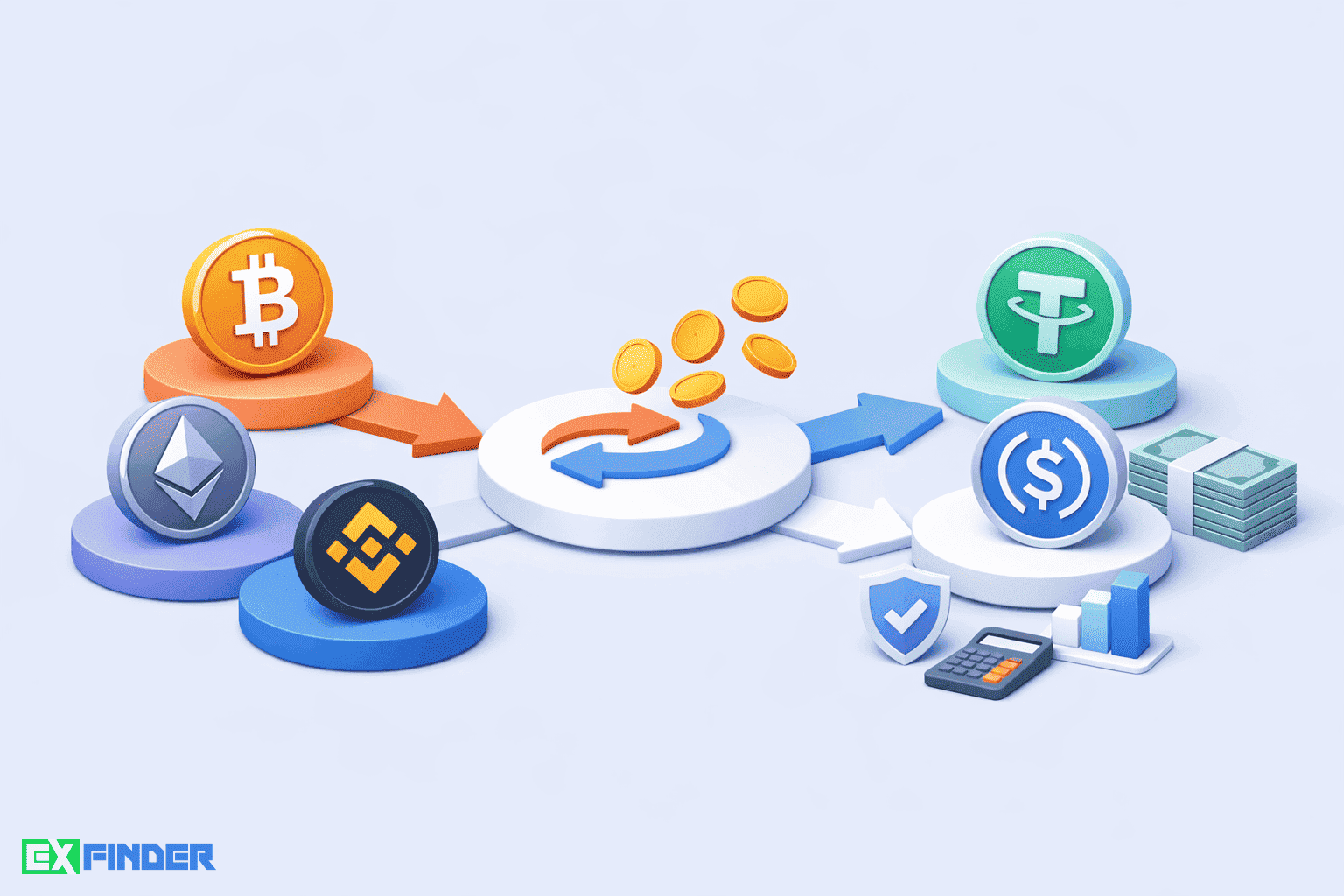
The most common route is converting on an exchange using trading pairs with stablecoins. Exchanges usually offer lower trading fees and deeper liquidity, which benefits larger volumes. For quick actions and smaller amounts, many users choose reliable crypto exchangers that allow swaps without complex onboarding.
An alternative workflow is using USDT exchangers to move into stablecoins quickly and then transfer to an exchange or wallet. In both cases, always check the network, minimum limits, and confirmation requirements to avoid delays. For users who frequently perform fiat-to-crypto exchange, combining exchanges with exchangers helps optimize fees and processing time.
Service comparison for stablecoin conversion
| Service type | Fees | Processing time | Supported assets | User ratings |
|---|---|---|---|---|
| Online exchangers | Medium or low exchange fees | Minutes | BTC, ETH, USDT and more | Varies by platform |
| Crypto exchanges | Low trading fees | Depends on network confirmations | Wide range of pairs | High among top crypto exchangers |
| P2P platforms | Variable | Instant to hours | Limited selection | Highly dependent on reviews |
Pros and cons of converting to stablecoins
Pros
- Reduced portfolio volatility exposure.
- Fast liquidity movement across services.
- Convenient for repeated trades and arbitrage.
- Simpler accounting in stable units.
Cons
- Conversion and network fees apply.
- Dependence on the issuer’s stability.
- Risks of choosing unreliable services or networks.
How to choose a service for conversion and liquidity management
- Check reputation and real user feedback.
- Compare top crypto exchangers by fees, speed, and limits.
- Review supported networks and minimums.
- Look for transparent terms and confirmation policies.
- Remember: the best crypto exchanger balances price, speed, and security.
Anti-fraud tips during conversion
- Use only verified services and reliable crypto exchangers with public track records.
- Verify domains and official support channels before initiating swaps.
- Start with test amounts on new routes or platforms.
- Keep transaction IDs until funds are fully credited.
- Avoid “too good to be true” offers without clear terms.
Practical steps: a detailed conversion checklist
- Select the asset to convert and the appropriate network based on fees and confirmation speed.
- Compare rates to secure low exchange fees without hidden costs.
- Confirm that the chosen service supports your target stablecoin and network.
- Run a small test transaction to validate the route.
- Save the TXID and monitor crediting status until completion.
- Scale up once the route is verified.
Common mistakes and how to avoid them
- Wrong network: always match sending and receiving networks.
- Ignoring limits: check minimums and maximums before converting.
- Chasing rates only: factor in fees and processing time.
- Rushing: errors increase when trying to decide where to buy Bitcoin profitably.
- No plan: define your conversion goal in advance.
FAQ
Is it safe to hold funds in stablecoins?
Stablecoins reduce volatility but carry issuer and peg risks. Diversify and avoid keeping all funds in one asset.
How much does it cost to convert to stablecoins?
Costs depend on service fees and network charges. Compare options to secure low exchange fees without hidden costs.
Is it better to convert on an exchange or via an exchanger?
Exchanges often provide better rates for larger volumes. Exchangers are more convenient for quick swaps and small amounts.
Which stablecoins are most practical for daily operations?
Popular stablecoins have broad support across USDT exchangers and exchanges. Choose assets available on networks with acceptable fees.
Does the network affect crediting speed?
Yes, networks differ in confirmation times and fees. Pick a network that balances speed and cost for your use case.
When should I move back from stablecoins to crypto?
When a favorable market opportunity appears or your strategy changes. Compare rates and liquidity before entering a position.
Conclusion
Converting cryptocurrency to stablecoins is an effective way to manage risk and liquidity without fully exiting to fiat. It is especially useful for users who regularly perform fiat-to-crypto exchange, rely on USDT exchangers, and compare top crypto exchangers for daily operations, as it enables quick profit locking and portfolio flexibility. When choosing services, prioritize transparent terms, processing speed, and reputation to find the best crypto exchanger for your needs.
Make discipline part of your workflow: verify networks, limits, and fees, start with test amounts, and keep confirmations until funds are credited. Slow down when deciding where to buy Bitcoin profitably and plan conversion routes in advance to improve predictability and reduce operational risk.