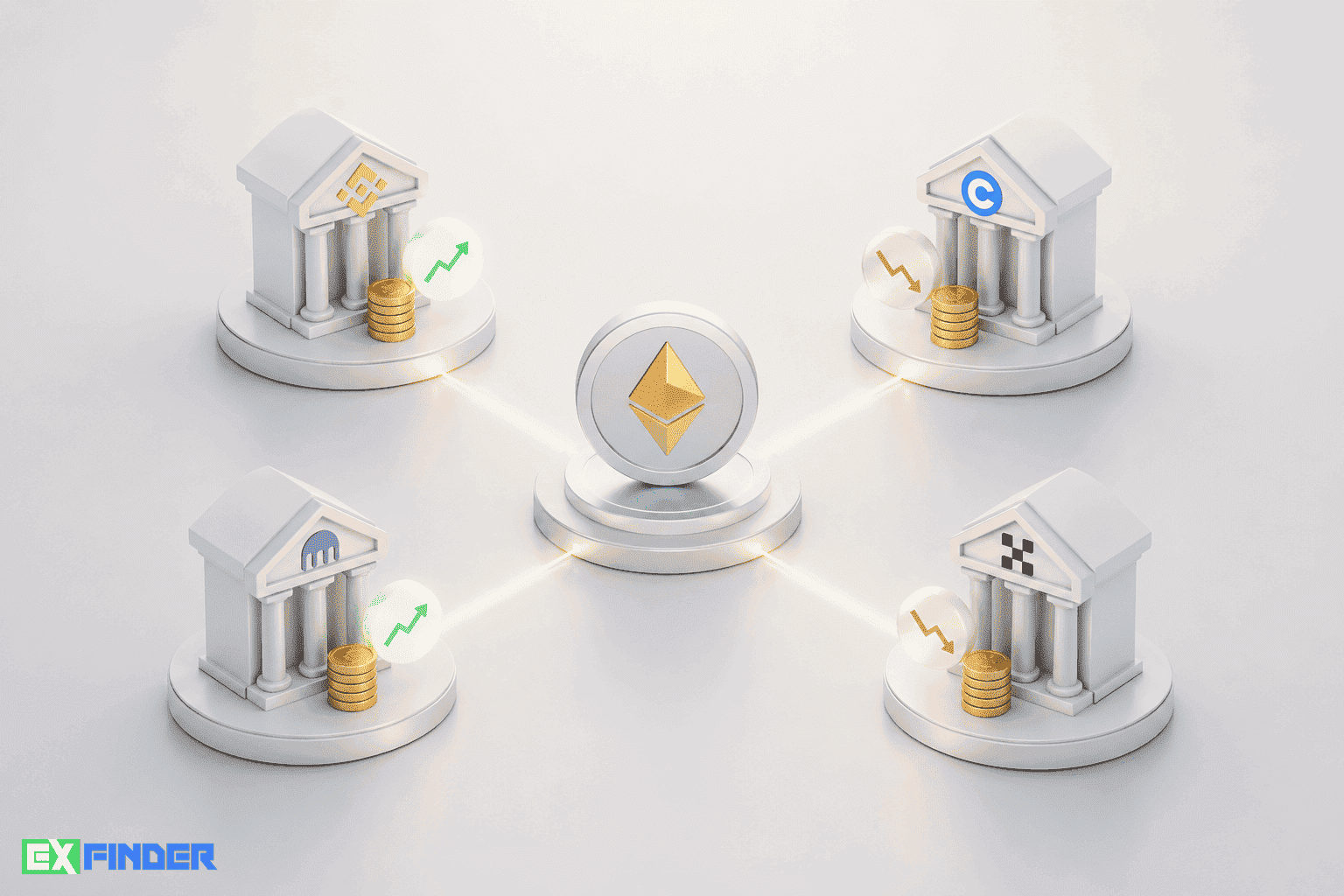
Users often notice a situation that seems strange at first: the same token may cost different amounts on a centralized exchange, in a crypto exchanger, on a P2P platform, or in a decentralized liquidity pool. This creates a logical question: why is there no single universal price for the whole market?
In reality, the cryptocurrency market is not one shared shop. It is a network of separate platforms where the price is shaped by demand, supply, liquidity, fees, execution speed, and local payment conditions. That is why users should understand how to read rates, compare offers, use top crypto exchangers, and why the lowest visible price does not always mean the best deal.
How a Token Price Is Formed on an Exchange
The price of a token on an exchange is formed by buyers and sellers. If more people want to buy an asset, the price may rise. If more people sell, the price may fall. This market principle works especially fast in crypto because trading runs twenty-four hours a day.
On centralized exchanges, the price is usually determined through an order book. It contains buy and sell orders. The closest sell price shows how much someone is ready to sell the token for, while the closest buy price shows how much someone is ready to pay. The difference is called the spread.
On decentralized exchanges, the price is often formed through a liquidity pool. Such a pool contains two or more assets, and an algorithm calculates the ratio between them. When a user buys a token, the pool balance changes, and the price changes too. That is why one large operation can strongly affect a small pool.
Crypto exchangers work differently. They can take rates from several sources, add their own reserve, include volatility risks, payment method, fiat currency, banking limits, and their margin. Therefore, a fiat-to-crypto exchange through an exchanger can have another final price than buying the same asset on an exchange.
Why the Same Cryptocurrency Has Different Prices
1. Different Liquidity on Different Platforms
Liquidity means how quickly an asset can be bought or sold without strongly affecting its price. If a platform has many buyers, sellers, and large order volume, the price is usually close to the wider market average. If liquidity is low, even a small trade can move the rate.
For example, a token can trade actively on a large exchange but have almost no volume on a smaller platform. On the large exchange, the spread will be smaller and the price more stable. On the small exchange, a seller can list the token higher because buyers and available volume are limited.
That is why the best crypto exchanger is not always the one with the lowest first visible rate. It is important to check reserve, rate fixing, processing speed, and whether the final amount can change after confirmation.
2. Different Demand in Different Regions
Cryptocurrencies are global, but demand for them is often local. In different countries, users may actively buy Bitcoin, USDT, or other tokens through bank cards, cash, bank transfers, or local payment systems. Because of this, the price in one region can differ from the global average.
For example, during increased demand for stablecoins, users may pay more for USDT if they want to move quickly from fiat into crypto. In this situation, USDT exchangers can show different rates depending on currency, bank, limit, country, and reserve.
When a user searches for where to buy Bitcoin, it is important to compare not only the BTC exchange price but also the full entry cost: service fee, bank fee, possible payment delay, fiat rate, and deposit speed.
3. Fees Are Included in the Rate or Shown Separately
One of the main reasons for price differences is how fees are shown. Some services display a market rate and add the fee separately during the order. Others already include the fee in the final rate, so the price may look higher at first glance.
Because of this, users should compare not only the rate but also the amount they will actually receive after the exchange. A low exchange fee matters only when the service clearly shows all costs and does not change conditions at the final step.
Reliable crypto exchangers usually show the exchange direction, minimum and maximum amount, reserve, approximate processing time, token network, and rate-fixing rules. This helps users understand the real cost before sending funds.
4. Different Networks of the Same Token
The same token can exist on different blockchain networks. For example, USDT is available on Ethereum, Tron, BNB Smart Chain, Solana, and other networks. Formally, it is the same stablecoin, but transfer conditions can differ greatly.
The network affects fee, confirmation speed, deposits, and withdrawals. If one network has a high fee or delay, a service can change the rate, limit reserve, or offer another network. Before an exchange, users should check not only the ticker but also the exact network.
A network mistake can be expensive. If a user sends an asset through the wrong network, funds may not be credited automatically or may be lost. That is why how to choose an exchanger includes both the rate and the technical conditions.
5. Difference Between Spot Price, P2P, and Exchanger Rate
A spot exchange price shows the market value of an asset in a trading pair, for example BTC/USDT or ETH/USDT. But if a user buys crypto with hryvnia, dollars, euros, or another fiat currency, one more layer appears — the fiat exchange rate.
On P2P platforms, prices are set by individual sellers. They consider their own risks, payment method, limits, bank transfer speed, and demand for a specific currency. Therefore, a fiat-to-crypto exchange through P2P can be profitable, but it requires careful counterparty checks.
Crypto exchangers are usually more convenient for users who want a quick operation without complex orders. Still, conditions must be compared. Top crypto exchangers may differ by speed, reserve, rate fixing, bank support, and verification requirements.
Main Factors That Affect Price Differences
| Factor | How it affects the price | What the user should check |
|---|---|---|
| Liquidity | Low liquidity increases the spread and can worsen the final rate. | Trading volume, exchanger reserve, and available exchange amount. |
| Service fee | It can be included in the rate or added separately. | The final amount to receive, not only the stated rate. |
| Token network | Different networks have different fees and confirmation speeds. | Whether the sending and receiving networks match. |
| Fiat payment | Bank transfers, cards, and cash can have different costs. | Payment method, bank limits, and possible extra charges. |
| Volatility | During sharp market moves, the rate can change quickly. | Whether the rate is fixed and for how long. |
| Counterparty risk | Less reliable services may attract users with unrealistic rates. | Reviews, rating, history, and transparency of conditions. |
How Crypto Exchangers Work and Why Their Rates Differ
A crypto exchanger is a service that helps users exchange one currency for another: crypto for crypto, fiat for crypto, or crypto for fiat. Unlike a classic exchange, the user usually does not place an order manually but creates a request under offered conditions.
The rate in an exchanger can depend on the liquidity source. One service may work with exchanges, another with its own reserve, and another through partner channels. If the reserve is limited, the rate may be worse. If the service has several liquidity sources, it can offer better conditions.
For the user, it is important to evaluate not only the rate number. Reliable crypto exchangers should have clear rules, customer support, reasonable limits, real reserves, work history, and transparent information about processing speed.
When a person searches for the best crypto exchanger, they are actually looking for a balance between a good rate, safety, speed, and convenience. If a service offers a rate much better than the market but has poor reviews or unclear conditions, this “profit” can become a risk.
Comparison of Exchange Service Types
| Service type | Fee | Processing time | Available currencies | User rating | Who it suits |
|---|---|---|---|---|---|
| Centralized exchange | Low or medium, but deposit and withdrawal fees may apply. | Fast for trades, but withdrawals depend on network and checks. | Many cryptocurrencies, fewer fiat directions. | High for major exchanges, but depends on the region. | Traders and users who understand orders. |
| P2P platform | Often included in the seller’s rate. | From a few minutes to longer, depending on the counterparty. | Popular cryptocurrencies and many local fiat methods. | Depends on the seller and arbitration system. | Users who need local banks or specific payment methods. |
| Online crypto exchanger | May be included in the rate; the final amount is important. | Usually from a few minutes to an hour, depending on direction. | Crypto, fiat, banks, cards, and electronic payment systems. | Depends on transparency, speed, and support. | Users who want fast, clear exchange without complex trading. |
| Decentralized exchange | Network fee plus pool fee. | Depends on blockchain and network load. | Many tokens within specific networks. | Depends on user experience and pool quality. | Web3 wallet users who control assets independently. |
Why the Rate Can Change During Request Processing
The crypto market is very fast. If a token actively moves in price, the rate can change within a few minutes. That is why exchangers often use rate fixing for a limited time. For example, a request can have a fixed rate for 10–20 minutes if the user completes payment in time.
If the payment arrives later, the service may recalculate the rate according to current market conditions. This does not always mean fraud. But reliable crypto exchangers should clearly explain such rules before the transaction starts.
Another reason is blockchain confirmation. If the network is overloaded, a transaction can take longer. During this time, the market can move. This is especially important for volatile tokens that can change by several percent quickly.
Therefore, a low exchange fee should not be the only criterion. If a service does not fix the rate or fixes it for a very short time, the final amount can differ from expectations. Users should read the rules, not only look at the advertising number.
Arbitrage: Can You Earn on Price Differences?
When a user sees that a token is cheaper on one exchange and more expensive on another, the idea of arbitrage appears. The idea is simple: buy where it is cheaper and sell where it is more expensive. In practice, it is more complicated.
It is necessary to include fees for buying, selling, transferring, withdrawing, depositing, fiat conversion, and also the time needed for the transaction. While the user transfers the token from one platform to another, the price can change and the expected profit can disappear.
Another risk is deposit or withdrawal restrictions. Sometimes an exchange can temporarily close withdrawals for a token or network. On the screen, the difference looks profitable, but in reality it cannot be used.
Arbitrage requires speed, capital, technical understanding, and discipline. For an ordinary user, it is more important to find safe conditions for buying or selling. That is why top crypto exchangers are useful: they help compare rates, reserves, and service parameters.
How to Understand Where to Buy Bitcoin or Another Token Profitably
To understand where to buy Bitcoin, users should not look at only one number. They need to compare the full picture: rate, fee, payment method, speed, reserve, reputation, and rate-fixing rules. Sometimes a slightly higher rate is better if the service is faster, clearer, and has no hidden payments.
For Bitcoin, the network fee is especially important. If a user buys a small amount, a fixed transfer fee can strongly affect the final result. For large amounts, limits, reserve, and service stability become more important.
If the topic is stablecoins, for example USDT, the network must be checked. USDT exchangers can offer different conditions for TRC20, ERC20, BEP20, or other networks. The fee difference between networks can be larger than the rate difference.
When a user plans a fiat-to-crypto exchange, the bank or payment method also matters. Some directions can be fast and cheap, while others can be slower or more expensive because of payment system limits. Therefore, the best crypto exchanger for one user is not always the best for another.
How to Choose an Exchanger: Practical Checklist
The question of how to choose an exchanger should be approached systematically. A good service is not only a good rate, but also a clear process, support, reserves, reputation, and safe rules.
- Check the final amount to receive, not only the rate in the first line.
- See whether there is enough reserve for your amount.
- Make sure the correct token network is selected.
- Clarify whether the rate is fixed and for how long.
- Check minimum and maximum exchange limits.
- Evaluate reviews, rating, and history of the service.
- Do not ignore KYC/AML rules if they may apply.
- Make sure the service has clear support.
Reliable crypto exchangers do not promise the impossible. They show real conditions, explain delay risks, list available currencies, and do not hide request rules. If a service pressures the user, promises an overly profitable rate, or asks for strange extra payments, it is better to stop.
Advantages and Disadvantages of Exchangers
| Criterion | Advantages | Disadvantages or risks |
|---|---|---|
| Convenience | Simple exchange process without complex trading tools. | The user must carefully check details and network. |
| Speed | Many directions are processed quickly, especially popular currencies. | Delays are possible because of bank, blockchain, or manual check. |
| Rate | Users can quickly compare offers and find a favorable option. | The lowest rate can hide a fee or weak reserve. |
| Fiat directions | Convenient for buying crypto with a bank card or local currency. | Bank limits can affect speed and availability. |
| Security | Ratings and reviews help choose a verified service. | Users must avoid unknown sites without history and clear terms. |
How to Avoid Fraud During Exchange
Fraudsters often use the user’s wish to get the most favorable rate. They can create clone sites, fake reviews, promise unrealistically low fees, or ask for an additional “insurance payment” after receiving funds.
The first risk signal is a rate that is much better than the market without a clear reason. If all services offer similar conditions and one site promises much more, it should be checked especially carefully. Reliable crypto exchangers cannot constantly work at a loss.
The second signal is the absence of clear contacts, rules, and history. If a service does not explain how the request works, how long the exchange takes, and what happens in case of delay or mistake, the user takes extra risk.
The third signal is pressure and urgency. For example, the user is told to pay extra immediately or funds will be blocked. In a normal exchanger, the rules are clear before the operation starts, and support should not force unexpected payments.
To avoid problems, it is better to use services that can be compared by rating, rate, reserve, and reviews. Top crypto exchangers help filter suspicious options faster and focus on realistic offers.
Why the Lowest Price Is Not Always the Best
At first glance, it seems that users should choose the service with the lowest buy price or highest sell price. But in real exchange, the important thing is not the advertised rate, but the final result. If a service has a hidden fee, weak reserve, or slow processing, conditions may be worse.
For example, one exchanger can show a slightly less favorable rate but process requests quickly, have a stable reserve, and clear rules. Another can show a better number but change the rate after request creation or require extra steps. In this case, the first option is safer.
A low exchange fee is important, but it must be part of the full evaluation. Users should look at all parameters together: rate, fee, limits, network, reputation, speed, support, and real reviews.
That is why how to choose an exchanger has no universal answer. For a small purchase, simplicity and minimal fee matter. For a large amount, reserve, stability, reputation, and safety rules matter more. For an urgent payment, speed and support matter most.
What to Do Before Exchange: Short Algorithm
- Define the exact direction: what currency you give and what you want to receive.
- Check the token network, especially for USDT, USDC, or another multi-network asset.
- Compare several services by final amount, not only by rate.
- Check exchanger reserve and limits.
- Check rate-fixing rules.
- Evaluate rating and reviews.
- For a large amount, first test the service with a small transaction.
- Save the request number and do not send funds to details outside the official form.
This algorithm helps reduce risks and better understand the real transaction cost. It is especially useful for beginners who are just starting with cryptocurrency and do not always understand why the rate changes between platforms.
FAQ
Why can the token price on Binance differ from the price in an exchanger?
An exchange shows the price inside its order book or market. An exchanger also considers its own reserve, payment method, fiat rate, fee, volatility risks, and processing speed. Therefore, the final price can be different.
Does a price difference mean easy arbitrage profit?
Not always. Users need to consider fees, transfer time, deposit and withdrawal limits, rate changes, and delay risk. In practice, the visible difference often disappears after all costs.
Where should a beginner buy Bitcoin at the best rate?
A beginner should compare not only the rate, but also final amount, fee, reputation, reserve, and process simplicity. If you are searching for where to buy Bitcoin, check several services and do not choose only by the lowest price.
Why do USDT exchangers have different rates?
USDT exchangers can work with different networks, reserves, payment methods, and fiat currencies. Because of this, the rate for USDT TRC20, ERC20, or another network can differ even for the same stablecoin.
How can I understand that an exchanger is reliable?
Check rating, reviews, work history, reserve, rate-fixing rules, support, and transparency. Reliable crypto exchangers do not hide fees, pressure users, or change rules after funds are sent.
What is more important: rate or fee?
The final amount you receive is more important. Sometimes the rate looks profitable, but the fee or network costs make the exchange more expensive. Look at the full result, not one separate metric.
How should I choose an exchanger for a large amount?
For a large amount, check reserve, limits, reputation, KYC/AML rules, support, and processing time. It is also useful to make a test transaction with a smaller amount first.
Conclusion
The difference in token prices across exchanges and exchangers is normal for the cryptocurrency market. It appears because of liquidity, demand, fees, networks, fiat payment methods, processing speed, and volatility risks. There is no universal price for all platforms, so users should evaluate the full transaction picture.
To find the best crypto exchanger, compare the rate, final amount, reserve, speed, reviews, rate-fixing rules, and security. Top crypto exchangers help users navigate offers faster, but the final decision should always be based on careful checking of conditions.
If you plan a fiat-to-crypto exchange, Bitcoin purchase, USDT exchange, or token sale for local currency, do not rush. Check several options, evaluate the real amount to receive, and choose reliable crypto exchangers with transparent rules.