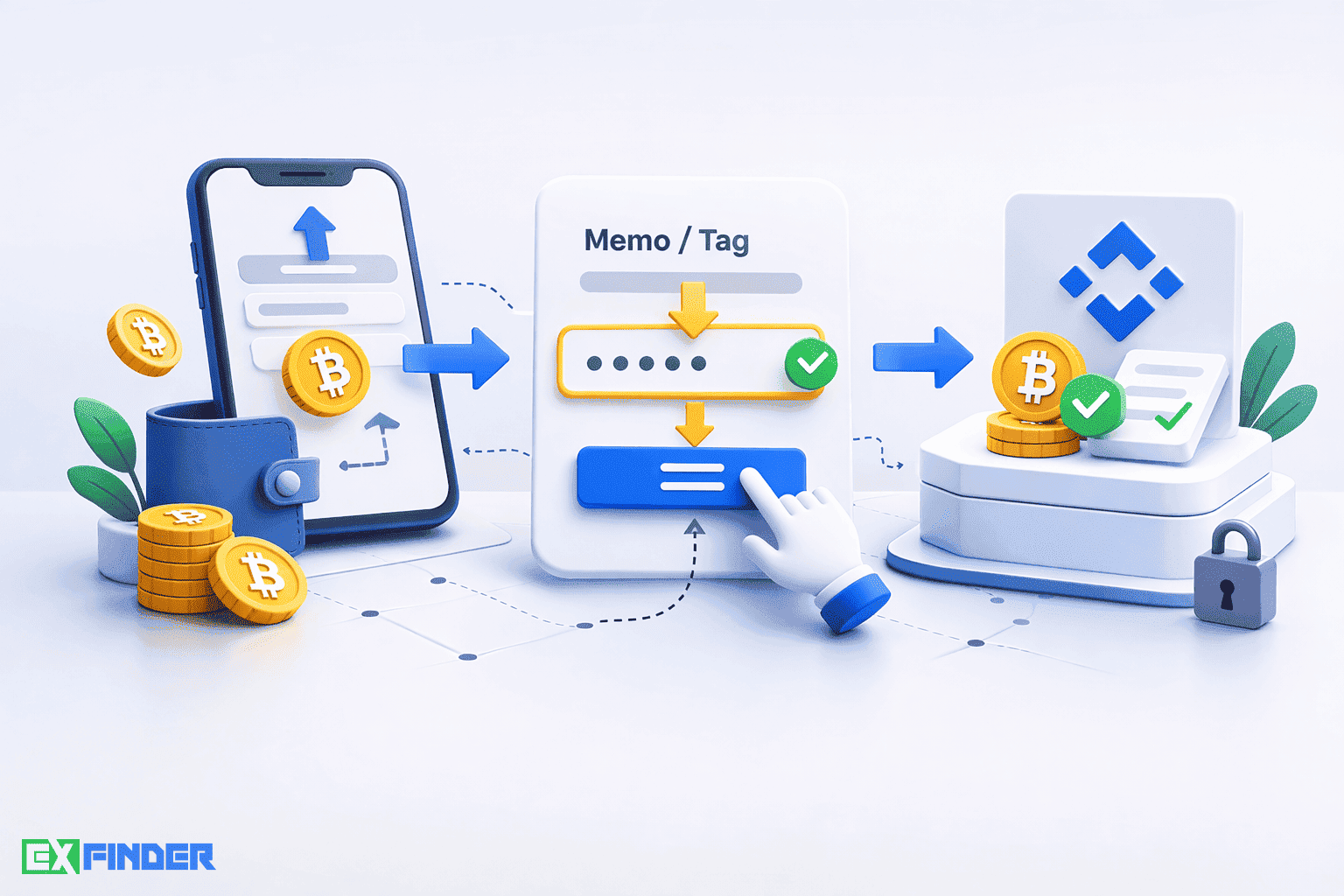
Memo/Tag is a service identifier used by some blockchain networks to properly attribute deposits on exchanges and payment platforms. When you send funds to an exchange, the address is often shared among many users, and the Memo/Tag tells the system which internal account should receive the funds. Because of this, even a small mistake, missing field, or reused value can lead to delayed crediting or manual support procedures. The risk increases when users perform fiat-to-crypto exchange, use USDT exchangers, and try to top up their balance quickly to trade. That is why filling Memo/Tag correctly is a critical skill for anyone who uses reliable crypto exchangers and compares top crypto exchangers regularly.
How exchange deposits work and the role of Memo/Tag
Many centralized exchanges rely on shared deposit addresses for specific networks. The Memo/Tag, Destination Tag, or Payment ID is used to map incoming transactions to individual user accounts. This simplifies infrastructure but shifts responsibility for accuracy to the sender.
After fiat-to-crypto exchange, users often forward funds to an exchange to start trading. Reliable crypto exchangers warn about Memo/Tag requirements, and top crypto exchangers duplicate these instructions on deposit pages, but the final check remains your responsibility.
Networks that require Memo/Tag
Not all blockchains require Memo/Tag, and most EVM and UTXO networks rely on unique addresses. Memo/Tag is commonly required for networks like XRP (Destination Tag), XLM (Memo), and EOS, as well as a few others depending on the exchange setup.
Always follow the exact deposit instructions for the selected asset and network. This is especially important when working with USDT exchangers, where the same token exists across multiple networks.
Pre-transfer checklist before sending to an exchange
- Network: make sure it matches the exchange deposit network exactly.
- Deposit address: copy it from the official exchange deposit page.
- Memo/Tag: copy it without spaces or extra characters.
- Fees: low exchange fees do not replace on-chain network fees.
- Test amount: start small for new routes.
- Confirmations: check how many confirmations the platform requires.
Step-by-step: how to fill Memo/Tag correctly
Step 1. Get deposit details from the exchange
Open the deposit page for the selected asset and network and copy both the address and Memo/Tag. Pay attention to the required format of the identifier.
Step 2. Paste the address into your wallet or service
Paste the address without manual edits to avoid typos. Manual entry increases the risk of errors.
Step 3. Enter the Memo/Tag field correctly
Paste the Memo/Tag exactly as provided by the exchange. Do not add comments or spaces.
Step 4. Verify network and fee
Double-check that the network matches the exchange requirements. Set a reasonable on-chain fee if you expect fast crediting after fiat-to-crypto exchange.
Step 5. Save the TXID and track status
Keep the TXID to track confirmations in a blockchain explorer. This helps when contacting support if crediting is delayed.
Common mistakes and consequences
- Missing Memo/Tag: the deposit will not be credited automatically.
- Wrong Memo/Tag: funds may be misattributed or require manual review.
- Wrong network: funds can be lost even with a correct Memo/Tag.
- Rushing: errors are more likely when trying to find where to buy Bitcoin profitably.
- Reusing old details: each deposit can have a unique identifier.
Deposit crediting scenarios comparison
| Scenario | Memo/Tag | Risk | Crediting time | Recommendation |
|---|---|---|---|---|
| Correct network + correct Memo/Tag | Provided | Low | After required confirmations | Save TXID and monitor status |
| Correct network without Memo/Tag | Missing | High | Delayed, manual support | Contact support immediately |
| Wrong network | Any | Very high | Potential loss | Double-check before sending |
Pros and cons of Memo/Tag usage
Pros
- Allows exchanges to use shared addresses efficiently.
- Helps platforms scale deposit infrastructure.
- Enables automated crediting for users.
Cons
- Extra step that is easy to miss.
- Errors are hard to fix after sending.
- Confusing for first-time users.
How to choose a service for sending to exchanges
- Choose reliable crypto exchangers with clear network and Memo/Tag instructions.
- Assess fee transparency and confirmation requirements.
- Compare top crypto exchangers not only by rates but also by support speed.
- Remember: the best crypto exchanger balances rates, speed, and security.
Security tips
- Copy details only from the official deposit page.
- Never reuse old Memo/Tag values.
- Double-check the network before sending.
- Start with test amounts.
- Keep TXIDs and screenshots until crediting is complete.
- Do not rush when deciding where to buy Bitcoin profitably.
FAQ
What should I do if I forgot to include Memo/Tag?
Your deposit may not be credited automatically and can remain on the exchange’s shared wallet. Contact support with the TXID and transaction details to request manual crediting.
What happens if I enter the wrong Memo/Tag?
The funds may be credited to the wrong account or require manual investigation. Recovery is not guaranteed, so always double-check the value before sending.
Is Memo/Tag always required when sending to an exchange?
No, it is required only for specific networks that use shared deposit addresses. Always follow the deposit instructions for the selected asset and network.
Do network choice and fees affect deposits with Memo/Tag?
Sending on the wrong network can lead to loss of funds regardless of Memo/Tag accuracy. Very low fees can delay confirmations and crediting.
Can I reuse an old Memo/Tag for a new deposit?
No, always use the current Memo/Tag from the deposit page. Old values can cause incorrect or delayed crediting.
How can I confirm that my deposit was credited correctly?
Check the TXID in a blockchain explorer for confirmations. Then verify that the deposit appears in your exchange account.
Conclusion
Filling Memo/Tag correctly is a critical step when sending funds to exchanges that use shared deposit addresses. Mistakes lead to delays, manual reviews, and unnecessary stress, especially for users who perform fiat-to-crypto exchange, use USDT exchangers, and rely on top crypto exchangers for active trading. When choosing services, prioritize clear instructions and transparent processes to find the best crypto exchanger for your workflow.
Make verification part of your routine: always check the network and Memo/Tag, start with test amounts, and keep TXIDs until crediting is complete. Slow down when deciding where to buy Bitcoin profitably, and you will minimize risk while ensuring predictable deposit outcomes.