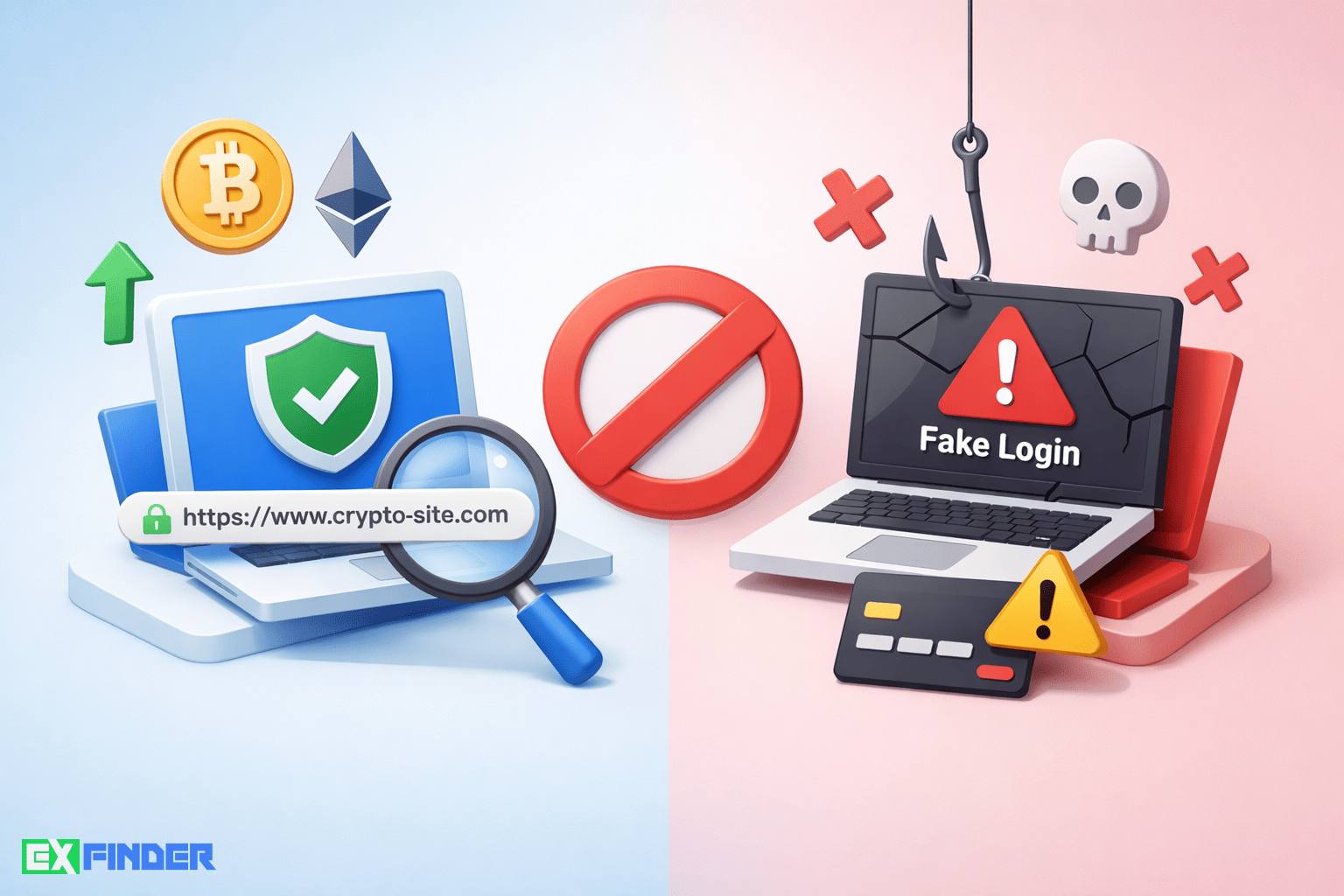
Phishing websites are one of the most widespread threats in the crypto space and directly target users’ wallets. Attackers clone the look and feel of well‑known services and pose as top crypto exchangers, wallet login pages, or “great deals” for people searching where to buy Bitcoin profitably. As a result, users reveal seed phrases, sign malicious transactions, or send funds to spoofed addresses. The risk grows during fiat‑to‑crypto exchanges and when dealing with USDT exchangers, because urgency and trust in familiar brands make mistakes more likely.
What phishing is in crypto and how it works
Phishing is a form of social engineering where attackers create convincing copies of websites, emails, and messages that imitate official services. In crypto, the goal is to gain access to assets: users are tricked into entering seed phrases or private keys, signing harmful transactions, or sending funds to attacker‑controlled addresses. Phishing often combines search‑ad hijacking, fake social profiles, and spoofed “partner pages” of fiat‑to‑crypto services.
The most vulnerable scenarios are rushed actions: when a user urgently performs a fiat‑to‑crypto exchange, clicks a sponsored link to find the best crypto exchanger, or picks USDT exchangers offering an “attractive rate.” Speed and brand familiarity lower vigilance and create room for costly mistakes.
What phishing websites look like: common signs
- Pixel‑perfect clones of popular services and top crypto exchangers with tiny visual differences.
- Domains with a one‑letter typo, extra characters, or unusual TLDs.
- Forms requesting seed phrases or private keys under the pretext of “verification.”
- Urgent alerts about “account issues” demanding immediate action.
- Pseudo‑promotions and “bonuses” with unrealistic promises.
- Substituted recipient addresses during fiat‑to‑crypto exchanges.
Step by step: how to vet a website before use
Step 1. Check the domain and your navigation path
Visit services only from your own bookmarks or a trusted listing. Avoid clicking ads without manually verifying the domain. Services that claim to be the best crypto exchanger usually keep the same primary domain for years.
Step 2. Verify TLS and connection warnings
HTTPS alone does not guarantee safety, but the absence of encryption or browser warnings is a red flag. Inspect certificate details if anything looks off.
Step 3. Never enter a seed phrase
No reliable crypto exchangers, wallets, or top crypto exchangers will ever ask for your seed phrase on a website. Any such request is phishing.
Step 4. Cross‑check transaction details
Before any fiat‑to‑crypto exchange, verify the receiving address and the network. With USDT exchangers, double‑check the network choice.
Step 5. Start with a test amount
Begin with a minimal transfer to confirm the flow works and the service behaves transparently.
How online exchangers work and where risk appears
Online exchangers accept one asset and pay out another. During fiat‑to‑crypto exchanges, the fiat leg happens off‑chain, while crypto payouts occur on‑chain. Phishing attacks the “entry point”: fake order pages or payment details redirect funds to attackers.
Even when relying on top crypto exchangers, verify the domain every time, ignore links from unsolicited messages, and slow down when searching where to buy Bitcoin profitably.
Comparing service types and phishing risk
| Service type | Phishing risk | How to verify | Trust level |
|---|---|---|---|
| Classic online exchangers | Medium | Domain history, TXID policy, confirmation rules | High when reputable |
| Offer aggregators | Medium | Navigate only from listings; manual domain checks | Partner‑dependent |
| Social media & messengers | High | Avoid links; verify profiles | Low |
| Search ads | High | Type domains manually; compare with bookmarks | Low |
Pros and cons of using exchanger listings
Pros
- Fast access to top crypto exchangers with operating history.
- Lower phishing risk thanks to domain moderation.
- Side‑by‑side comparison of conditions and low exchange fees.
Cons
- Domains still need periodic verification.
- Fake copies may exist outside listings.
How to choose a safe and reliable exchanger
- Check domain age and stability.
- Review user feedback and support responsiveness.
- Use test amounts for the first transaction.
- Pay attention to USDT exchangers and correct networks.
- Do not focus solely on where to buy Bitcoin profitably—transparency matters.
- Ensure TXIDs are provided and confirmation thresholds are explained.
Practical tips to avoid scams
- Use your own bookmarks to access services.
- Do not trust ad links without manual domain checks.
- Store funds in hardware wallets.
- Enable two‑factor authentication everywhere possible.
- Keep browsers and extensions updated; block shady ads.
- Review login/activity history regularly.
- Never share your seed phrase.
Pros and cons of fast swaps from a security perspective
Pros
- Quick fiat‑to‑crypto onboarding.
- Wide route coverage, including USDT exchangers.
- Competition encourages low exchange fees.
Cons
- Rushing increases phishing risk.
- Typos in domains are easier to miss.
- Errors with addresses or networks are costlier.
FAQ
What should I do if I entered my seed phrase on a fake site?
Immediately move funds to a new wallet, generate a new seed phrase, and consider the old wallet compromised. Review connected services and rotate access where applicable.
Can phishing impersonate top crypto exchangers?
Yes. Clones often copy branding and text with minimal domain differences. Always verify the URL manually.
Is it safe to buy via search ads?
Ads may lead to spoofed domains. Use bookmarks or a trusted listing and type domains manually.
How can I safely check where to buy Bitcoin profitably?
Compare services in a listing, verify domains by hand, start with test amounts, and choose reliable crypto exchangers with transparent rules.
Does a VPN protect me from phishing?
No. A VPN does not verify domains or prevent social‑engineering attacks.
How do I reduce the risk of address substitution during exchanges?
Verify the first and last characters of addresses, confirm the network, and re‑check details before sending.
Conclusion
Phishing websites remain a core threat for crypto users, especially in rushed situations: during fiat‑to‑crypto exchanges, when using USDT exchangers, or while comparing where to buy Bitcoin profitably. Protection starts with basic habits: manual domain checks, never entering seed phrases on websites, and using listings to filter services. When choosing top crypto exchangers, place transparency and domain stability on par with rates and speed.
Make security part of your workflow: start with test amounts, verify addresses and networks, use hardware wallets, and ignore “urgent” prompts. This reduces loss risk and lets you work with reliable crypto exchangers without compromising safety.